
Our enabling strategies and plans
Our vision and values are at the heart of all we do.
Our vision and core values were updated in 2023. We did this in consultation with service users, carers, staff, governors and other partners.
Our values are what bind us. We have considered these in the light of what people have asked of us. We believe that these are the values that we share together, and that we need to uphold if we are to meet our commitments.
At Cumbria, Northumberland, Tyne and Wear NHS Foundation Trust, we are committed to developing services of the highest quality that consequently enable and empower our service users to reach their potential and live fulfilling lives.
Our vision
To work together, with compassion and care, to keep you well over the whole of your life.
Our values
We are caring and compassionate…because that is how we’d want others to treat those we love.
We are respectful…because everyone is of equal value, is born with equal rights and is entitled to be treated with dignity. We want to protect the rights of future generations and the planet that sustains us all.
We are honest and transparent…because we want to be fair and open, and to help people make informed decisions.
Our strategic ambitions
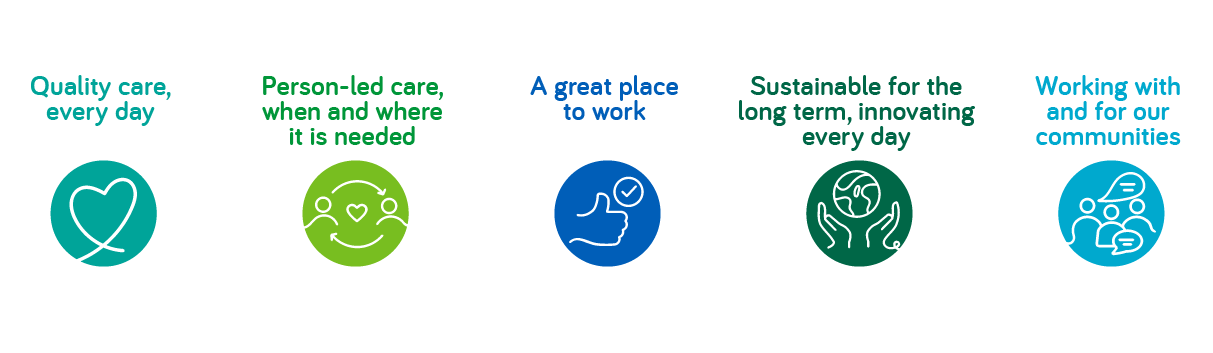
Quality care, every day – We will aspire to deliver expert, compassionate, person-led care every day, in every team. We will value research and learning.
A great place to work – We want to be a great place to work. We will make sure that our workforce has the right values, skills, diversity and experience to meet the changing needs of our service users and carers.
Person-led care, when and where it is needed – We will work with partners and communities to support the changing needs of people over their whole lives.
Sustainable for the long term, innovating every day – We will be a sustainable, high performing organisation, use our resources well and be digitally enabled. We will be accountable for the money we spend; we will live within our means, and we will work in a way that is kind to the planet.
Working with and for our communities – We will create trusted, long-term partnerships that work well together to help people and communities.
With you in mind - our strategy from 2023
Our message to you
This strategy is more than a document. It is a promise. A promise to listen, to act, and to stand alongside the people and communities we serve - especially in times of change, challenge and opportunity.
Our strategy is called, With you in mind, because everything we do begins with empathy, compassion and connection. It reflects our shared belief that care should be personal, respectful, and rooted in understanding. Our strategy is shaped by the voices of our service users, carers, families, staff and partners - those who know best what matters.
But this strategy is also a response to a wider call for change. The NHS 10-Year Plan sets out a bold vision for a healthier, fairer future. A plan which prioritises prevention, tackles inequalities, embraces digital innovation, and strengthens care in communities. Our strategy aligns with this vision. It is our local blueprint for delivering national ambition.
We know the world around us is shifting. The NHS is facing unprecedented challenges. Whilst we all live with these challenges and are aware that health inequalities have deepened, the need for joined up person-led care has never been more clear. We need to be ready to meet that need - not alone, but in partnership. With our partners in primary care, local authorities, voluntary organisations, and most importantly, with you. Together, we will rise to the challenge.
We know that many people who come to us for support have experienced trauma. That’s why we are committed to embedding trauma-informed care across everything we do. This means creating environments of safety, trust, and empowerment. Places of safety where people feel heard, respected, and understood. It means recognising the impact of trauma not just on individuals, but on families, communities, and staff. And it means working in ways that promote healing, resilience, and hope.
This is a time to be bold. To reimagine how care is delivered. To move from crisis response to prevention. To empower people to take control of their health and wellbeing. To make every contact count.
Our strategy reflects the commitments we will live by, the values that guide us, and the ambitions we will pursue. It is a living document - one that will evolve, grow, and respond to the needs of our communities. It is not just about what we do, but how we do it. With integrity. With courage. With you in mind.
Darren Best, Chair
James Duncan, Chief Executive
Cumbria, Northumberland, Tyne and Wear NHS Foundation Trust is a health organisation made up of 9,000 people across our region.
We spend more than £500 million each year, providing healthcare across North Cumbria, Northumberland, Newcastle, North Tyneside, Gateshead, South Tyneside and Sunderland. Along with partners, we support people in their own homes, in their communities and in our hospitals. We help:
- People with mental ill-health
- Children and young people
- People with a learning disability
- People with neurodevelopmental conditions
- People who need support from secure services
- People with neurodisabilities
- People with problematic substance use or addictive behaviours
We also provide specialist support such as perinatal, mental health for Deaf people and
gender dysphoria services.
To develop our strategy, we asked service users, carers, their families, our staff and partners to describe what matters to them.
They asked us to work together, with them in mind, with compassion, humanity and care. This is at the heart of this strategy.
We have developed long-term commitments in response to these asks, which will guide everything we do. We know that we are not currently achieving these commitments – but we want them to be our guide. We want these commitments to be our inspiration for how we work and how we change over the years ahead.
Our aim is to deliver on these commitments every day, in every contact. In this document we set out how we will meet these commitments, through our vision, our values, and the ambitions that we are setting ourselves.
Commitment to our service users:
- Understand me, my story, my strengths, needs and risks. Work with me and others, so I can keep healthy and safe;.
- Protect my rights, choices and freedom;
- Respect me and earn my trust by being honest, helpful and explaining things clearly;
- Support me, my family and carers in an effective, joined-up way that considers all my needs, and
- Respond quickly if I am unwell or in crisis, arranging support from people with the right expertise. Make sure I don’t have to keep repeating my story.
Commitment to our families and carers (also known as our ‘Carer Promise’):
- Recognise, value and involve me;
- Work with me to ensure you’re aware of my needs as a carer;
- Listen to me, share information with me, and be honest with me when there is information you can’t share;
- Talk with me about where I can get further help and information, and about what I can expect from you.
Commitment to our staff:
- Respect me for who I am, trust me, value me and treat me fairly;
- Allow me freedom to act, to use my judgement and innovate in line with our shared values;
- Protect my time by making systems and processes as simple as possible so I can deliver the work I aspire to, learn, progress & get a balance between work & home;
- Offer me safe, meaningful work and give me a voice, working as part of a team that includes other professions and services, and
- Support me with compassionate managers who communicate clearly and understand what it’s like to do my job.
Commitment to our partners and communities:
- Explain what to expect from CNTW;
- Help us to fight illness, unfairness and stigma;
- Make sure that organisations talk to each other and put the needs of people’s before their own. Share responsibility for getting things right;
- Get to know local communities. Respect their wisdom and history;
- Be responsible with public funds;
- Share our buildings, grounds and land; and
- Protect the planet
Our vision
To work together, with compassion and care, to keep you well over the whole of your life.
Our values
Our values are what bind us. We have considered these in the light of what people have asked of us. We believe that these are the values that we share together, and that we need to uphold if we are to meet our commitments.
We are caring and compassionate…
because that is how we’d want others to treat those we love.
We are respectful…
because everyone is of equal value, is born with equal rights and is entitled to be treated
with dignity. We want to protect the rights of future generations and the planet that sustains
us all.
We are honest and transparent…
because we want to be fair and open, and to help people make informed decisions.
Our five ambitions
To deliver our commitments and the care that we want to achieve, we have five ambitions in this strategy.
We want to deliver expert, compassionate, person-led care in every team, every day.
We will aspire to deliver expert, compassionate, person-led care every day, in every team. We will value research and learning.
We will act fairly and with compassion. We will uphold people’s rights to live safe, meaningful lives in their communities. We want people to live their best lives.
Together, we will work to understand the needs, goals and risks of each person. This will help us to provide joined-up, long-term care and support. We will work to ‘Triangle of Care’ principles across all services, to build trusted relationships between staff, service users and their carers/families. Evidence-based treatment will be provided by skilled staff to deliver the goals that people want for themselves. The care we provide will be therapeutic, person-led and trauma-informed.
We value learning and we will be informed by research. We will develop the skills of our staff so they can thrive. We will learn from each other, and from others. We will use our curiosity and courage to try new things.
We will be a leader in research, using our expertise to test, learn and embed new technologies and new ways of working. These will bring proven benefit to the people and communities we serve.
We will be open and honest if things go wrong. Every day we will challenge ourselves to learn, improve and do better. We will communicate effectively and simply, in a way that we can all understand.
We will work with partners and communities to support the changing needs of people over their whole lives. We know that we need to make big, radical changes. We want to transfer power from organisations to individuals.
We know that we need to make big, radical changes. We want to transfer power from organisations to individuals. The focus of services is often about managing crisis. We want to shift towards a focus on people keeping themselves well.
Community based care for adults and older people with mental ill-health
We want to remove things that make current services difficult for people to understand. People should be able to reach the support they need when they need it. We are committed to making a radical shift in our approach.
GPs, primary care and community organisations are at the heart of supporting people all through their lives. Each community has its own support and care networks, which we want to work alongside. This will wrap care around the person that needs it. We want to make sure that each person has one story that is understood by all. At any time, people should have access to care and support that is right for their needs. This care and support should be from the organisation that is best placed to meet those needs.
We will work with our partners to create new models of care and support which are simple, easy to access and built on strong, trusted relationships.
Together we will work with people and families to help them to live well in their communities. Together, we will prevent crisis and act early when extra support is needed.
Sometimes people need very specialist support and therapeutic care. We will make sure that we have well trained, skilled people who can respond quickly to provide the right support when it is needed.
We want people get the right care from the right service at the right time. This could be from their GP, social care, community groups, charities, or mental health services.
We will take a radical approach in how we deliver community based care which will:
- Consist of services and teams working together and rooted in our communities;
- Move away from a confusing system of referrals, assessments and treatment, to one of constant support and easy access to the right support at the right time;
- Enable expert advice, support and skilled clinical help is available from our teams when they are needed;
- Make sure that there is support available for people all day, every day, within their communities, to meet their needs and enable them to keep well;
- Provide intensive wrap around support for people who need it most;
- Develop our services with our partners to address the areas of greatest need and health inequality;
- Develop real alternatives to inpatient care with our partners across our places so that where possible, we can support people in crisis within their own communities.
Inpatient care for adults and older people with mental ill-health
We want to make big changes to inpatient services for adults and older people with mental ill-health.
When people are in hospital, we will protect their human rights every day. We will make sure our inpatient wards are welcoming and support healing. We will make sure staff have the right skills to support effective treatment.
When people are ready to go home or need to move to a different ward, we will make sure this goes smoothly. We will work with social care, housing providers, GPs and primary care so people stay well after their hospital stay. We will also design services that avoid hospital stays.
We will listen to service users, carers and families, to make care personal and improve things for all inpatients.
We will protect rights and be open. We will create safety for people to talk about their concerns. An open culture and rights-based approach will mean that:
- people will only be admitted to inpatient care if and when they need it;
- we will always clear on the reason and benefit of admission;
- people will not need to wait to be admitted;
- people will not be admitted to hospitals that are very far away from home;
- inpatient care will be personalised, therapeutic and effective;
- staff will have the specialist skills needed to provide personalise, therapeutic effective care;
- inpatient care will be safe;
- there will be no avoidable long term segregation or seclusion. People will not be kept on their own for a long time;
- we will support people to return home to their communities as soon as they are able; and
- people will not stay in hospital longer than they need to.
Children and young people
Children and young people, their families and carers should get the support they need.
Good physical and emotional wellbeing can prevent long-term problems and help people live healthy, happy lives.
We support children and young people:
- with their emotional wellbeing,
- with mental ill-health, and
- after big life events.
Support will be linked across GPs, paediatrics, schools, colleges and community groups to wrap around families. We will improve our services for children and young people who need a stay in hospital.
We will support services to be very different so that children and young people can receive the support that is best for them. We will work with other organisations to:
- provide the right help and support to young people and families when it is needed;
- make sure that there are no long waiting times for help;
- make sure that the needs, risks and challenges of the child/young person are understood as soon as possible;
- make sure that help and support is available while waiting for a diagnosis or without a diagnosis;
- make sure that help is based on the needs of the child/young person and their family;
- create spaces that children and young people feel safe to go to;
- safeguard the rights of children and young people at all times;
- support families in everything we do;
- work with other organisations to offer better support for children and young people with complex needs, and their families, so they can live well in their own communities; and
- make sure support doesn’t stop when a young person turns 18 and help them adapt to services for adults.
People with a learning disability
People with a learning disability should be treated with humanity, dignity and respect.
People with a learning disability should receive healthcare just like everyone else. If they need extra support to stay well and have a good life, they should receive it. Sometimes support will be provided by a service that is only for people with a learning disability. Services that help everyone will make changes so that their support is suitable for someone with a learning disability.
People with a learning disability should only go to hospital when they really need to. This should be close to where they live. When someone with a learning disability is in hospital, we will always protect their rights. We will work with other organisations so that people in hospital can go home as soon as it is right for them.
We will work with other organisations so people with a learning disability stay healthy and live well in their communities. We will:
- support people in their own homes;
- think about how we use medicines, so we don’t give people medicine they don’t need;
- meet people’s physical and mental health needs at the same time;
- make sure staff understand the needs of people with a learning disability, and
- communicate in a way that works so we understand each other.
People with neurodevelopmental conditions
Neurodevelopmental conditions include:
- Autism;
- Attention Deficit Hyperactivity Disorder (ADHD);
- Dyslexia;
- Dyspraxia;
- Dyscalculia; and
- Tourette Syndrome.
People with these conditions are sometimes described as ‘neurodivergent.’
Neurodivergent people are entitled to the same healthcare as everyone else. Making services suitable for neurodivergent people makes them better for everyone. This includes services that are not specifically for autistic people, for example, mental health wards. We will work with other organisations to make sure people only stay in hospital if they really need to.
We will improve our understanding of neurodiversity, neurodivergence and the increased risk of suicide in autistic people.
We will make sure staff have the training to support people effectively. We will make sure there is early support to diagnose and identify the needs of autistic people, people with ADHD and their families.
We will review how we use medicine with people because of their neurodivergence or behaviours of concern. We will make sure that we don’t give people medicine they don’t need.
We will make things easier for people to understand and we will respect their communication preferences.
People who need support from secure services
Secure services provide safety and real change for a better life.
Secure services provide treatment for people with complex mental disorders linked to offending or seriously harmful behaviour. Some will be involved with the criminal justice system (CJS), courts and prison. Secure services help people gain a deep understanding of themselves and their history.
The Secure Care Provider Collaborative is a partnership with Tees, Esk and Wear Valley NHS Foundation Trust and other organisations.
We will help service users gain new skills, understanding and ways of responding to things they find difficult. This will help people move on from secure settings and have more freedom, choice, and control in their lives. We will do this by focusing on:
- mental health;
- dealing with strong feelings;
- addictive behaviours;
- risk to others;
- physical health;
- social skills;
- relationships;
- meaningful activities; and
- trust and hope.
People with neurodisabilities
We help people with brain diseases or injuries to be as independent as they can in their everyday activities.
We will work with GPs, other hospitals, social services and other organisations to:
- tackle issues that stop people from being admitted to inpatient care;
- tackle issues that stop people from being discharged when they are ready;
- make sure therapy services are available every day (including weekends);
- shorten the time that people wait for outpatient care or community care, and
- make it easier for people to come to appointments.
People with problematic substance use or addictive behaviours
People can recover from their problems with substance use or addictive behaviours.
We will help people get well and stay well by working with them, their families or carers and charities.
We will make sure that services are joined-up and that there are services available for everyone.
If people have mental health problems alongside their problematic substance use or addictive behaviours, we will help them with both.
We will improve services based on changing needs, for example problematic gaming and gambling behaviours.
We will work to the principles of:
- ‘everyone’s job’ (services will work together to meet the needs of people), and
- ‘no wrong door’ (however people come into contact with services, they will be offered care and support that is personalised to meet their needs)
We want to be a great place to work. We will make sure that our workforce has the right values, skills, diversity and experience to meet the changing needs of our service users and carers.
We cannot deliver our commitments without meeting the needs of our staff and enabling them to thrive. We will invest in staff wellbeing, supporting our workforce to feel valued and safe, to meet their potential and support delivery of high quality care.
Quality of care is improved by having a workforce that represents our communities. We will build a culture of respect, trust and psychological safety, celebrating diversity and making sure staff feel safe to raise concerns.
We will work with partner organisations, including universities, to recruit, develop and retain our people.
We will simplify the way that we work. We will create time for staff to care and learn, be open to new ideas and encourage innovation and research.
We will be a sustainable, high performing organisation, use our resources well and be digitally enabled. We will be accountable for the money we spend; we will live within our means, and we will work in a way that is kind to the planet.
We have an opportunity to change. To be sustainable and innovative, we will support people to adapt, to be flexible and to try new ways of working.
To be truly innovative, we must be courageous and willing to learn by trying new approaches. We must work in a way that frees people and teams to improve every day and meet our commitments.
We will be a digital leader. We want to use technology in a way that empowers our people and teams to have the time and information they need to do their job.
We will make best use of our buildings and grounds, ensuring that they are fit for purpose and a resource for our communities. We will test, develop and grow new ventures and opportunities that help us meet our commitments.
We will create trusted, long-term partnerships that work well together to help people and communities.
Integrated Care Systems (ICSs) are partnerships of organisations. They come together to make sure that health and care services are well planned and joined-up. ICSs have been created to improve the lives of people who live and work in their area.
We are part of the North East and North Cumbria Integrated Care System (ICS). To meet our ambitions, we cannot work alone. To support our people and places, we must work together with the public and our partners in:
- Health;
- Education;
- Housing;
- Industry;
- Charities and volunteers.
Together, we will address the wide inequalities that contribute to ill-health across our region.
The North East and North Cumbria regional healthcare plan is called “Better Health and Wellbeing for All”. The plan seeks to improve health and care for all of us. All organisations in the North East and North Cumbria ICS agree that we want:
- Better, high quality health and social care services, no matter where you live or who you are;
- Fairer health outcomes. We know that some people have worse health because of where they live, their income, their education or their employment. We will take these factors into account to make good health more equal;
- Longer and healthier lives. We want to reduce the gap between how long people in our region live compared to the rest of England;
- Our children to have the best start in life, so they thrive and have great futures. This will have a long-term impact, improving lives for generations of children to come.
We are happy to work with our partners to achieve this regional plan. This strategy explains how we will work with them to provide care and support that is rooted in our communities.
Our strength is providing expert, evidence-based advice, support and care for people with complex needs. We provide this when it is needed. We also know that people want constant care and support close to home at all stages of their lives. For this to happen, we must work as a collective with partners in the interests of those we serve. We must work particularly well with primary care. We have lots to offer in support of the regional plan to improve the health and wellbeing of the population. We believe we can be a great partner in delivering care and a great partner to our communities.
- We will work with communities and value their strengths. GPs and primary care are at the heart of healthcare in each community. Also important are the volunteers, charities and self-help groups that do so much to bind a community together;
- With partners, we will teach, train, advise and help people and communities to support their own wellbeing;
- We will make every contact count, to tackle the causes of ill health and shortened lives. This means thinking about someone’s physical, emotional and social wellbeing each time we work with them.
- We will reach out and serve all communities, particularly those that are disadvantaged, to reduce inequalities and achieve fairer outcomes;
- We will use our power as an employer, as a purchaser and as a landlord to reduce inequalities.
- We will work every day to reduce suicides;
- With partners, we will radically change our offer to children, young people and their families to provide joined-up care and support; and
- We will support our communities by meeting their local needs.
How will we deliver this strategy?
This strategy is our guide.
We must all own it and consider it in everything that we do. Each year we will develop plans to support the delivery of our strategy. These will explain what we will do in each year to deliver this strategy. The plans will consider national policies and priorities but will always be guided by our commitments, values and ambitions set out in this strategy. It will set out specific actions for each area of this strategy, how we will achieve them and what we expect to see as a result.
Perhaps most importantly, we will build this strategy into the work of every person and every team across the organisation.
This strategy will not be delivered without us all playing our part, through the decisions we make and the behaviours we demonstrate every day. This is a document to enable devolution, to guide decision making and to bind us together in the way we work and the goals we aspire to.
We will work to make it a reality every day, in everything we do.
For a PDF of our strategy and an easy read version please visit this page.