

This leaflet provides information and support about experiences you could encounter when living and dealing with Down's syndrome and dementia.
The Northumberland Community Learning Disability Team have a range of staff who can offer support. Staff include:
- Learning Disability Nurses
- Specialist Learning Disability MacMillan Nurse
- Specialist prescribing team
- Consultant Psychiatrist
- Clinical Psychologists
- Support access to Learning Disability physiotherapy services
The team work in close partnership with Northumberland County Council Social Care who may provide Social Workers and Care Managers. Northumbria Health Care NHS Foundation Health Trust may also offer Speech and Language and Occupational Therapist support.
All partners will work with your registered General Practitioner (family doctor).
Contact details for your nearest Community Learning Disability Team: 01670 844 799.
Dementia can affect all aspects of life, both for the person living with dementia, their family, friends and wider circle of support.
Listed below are some experiences you could encounter when living and dealing with dementia.
Relationships
Living with dementia can place a strain on relationships, both for the person, their carers and their friends.
Health
Both the person living with dementia and those around them can experience health problems. Seeking help at the correct time, from the correct person can often help.
Mood (Wellbeing)
Mood may be affected due to a variety of reasons – loss of self-esteem, self-help skills. Carers may experience stress and fatigue.
Planning
Advance care is important to plan ahead for the person living with dementia; by seeking out appropriate interventions and support. This leaflet may help with part of the planning process.
Embarrassment
In understanding any changes that may be occurring this can reduce embarrassment for the person with dementia, their family and friends and provide opportunities to talk though problems with their circle of support.
Loss
Dementia is often called the long bereavement. The person with dementia has what is deemed a social death (a loss of social skills and ability to be involved in making their own choices). This often happens a good while before the actual biological death. The person with dementia’s actions, behaviour or personality can change dramatically. This causes concern for them and their family and friends. People often comment “they’re not the same person”.
Social Life
Both the person living with dementia and their family’s social life can be affected, resulting in stress, irritability and resentment.
- More information and knowledge about dementia
- Being able to talk to others with personal experience of dementia
- Short-breaks away from caring, including support from friends and professionals
- Disorientation
- Confusion
- Problems with making decisions
- Reduced interest in activities
- Inability to learn new things
- Seizures/myoclonic jerks may occur in early stage in some people
- Person is not aware that they forget things
- Wandering/restlessness
- New short-term memory loss
- Change in usual communication
- Loss of social skills
- Loss of daily living skills
- Agitation
- Fluctuating mood
- Emotional instability
- Change in sleep pattern
- Food preferences may change as a result of changes to taste.
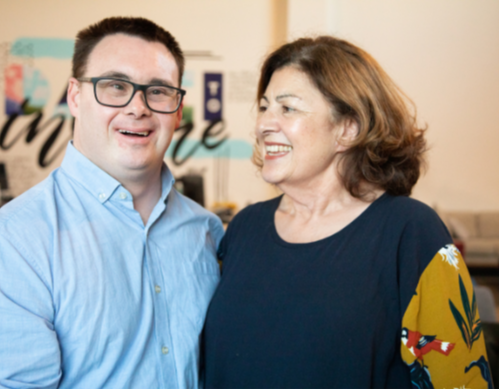
David is a 45-year-old man living at home with his parents. He has recently been unable to recognise familiar people who come into the shop where he works. Work colleagues and family think he may be starting to show signs of dementia.
On investigation it transpires that David's eyesight had deteriorated. David now has new glasses, and he can now recognise those customers who come into the shop.
- Poor eyesight
- Inflammation of the cornea
- Cataracts
- Hearing loss
- Constipation
- Spine disturbance
- Poor diet – leading to nutritional problems or anaemia
- Side effects of medication
- Sleep apnoea/lack of sleep
- Menopause
- Recent bereavement or significant change
- Obsessive Compulsive disorders
- Osteoporosis
- Urinary tract infection
- Changes in knee or hip joints
- Depression
- Cardiac abnormalities – especially if undetected in earlier life
- Hypothyroidism
- Diabetes
Adults with Down’s syndrome are more susceptible to the things below, that can often be confused with dementia:
- Poor eyesight
- Inflammation of the cornea
- Cataracts
- Hearing loss
- Constipation
- Spine disturbance
- Poor diet – leading to nutritional problems or anaemia
- Side effects of medication
- Sleep apnoea/lack of sleep
- Menopause
- Recent bereavement or significant change
- Obsessive Compulsive disorders
- Osteoporosis
- Urinary tract infection
- Changes in knee or hip joints
- Depression
- Cardiac abnormalities – especially if undetected in earlier life
- Hypothyroidism
- Diabetes
There are some treatable conditions that have similar signs and symptoms to dementia. Some of the conditions may be present along with the dementia, or they may be the presenting problem themselves.
It is important that any treatable condition is ruled out before assuming that a person has dementia. Regular health checks and screening can identify treatable conditions that may also be present along with dementia.
It is important to monitor and record changes between appointment with the GP or other professional. This may help with the treatment and care options available.
Leading to issues such as:
- Confusion
- Depression
- Personality changes
- Distress
Staff who can help:
- Community nurse
- Psychologist
- Psychiatrist
- Social Worker and Care Manager
- Speech and Language Therapist
- General Practitioner (GP)
- Occupational therapist
- Audiologist
Leading to issues such as:
- Falling/tripping
- Confusion
- Not recognising things
- Communication difficulties
- Skill loss
- Ignoring people
Staff who can help:
- Care Manager
- Occupational therapist
- Consultant
- Optician
- Community Nurse
- Social Worker
- General Practitioner (GP)
Leading to issues such as:
- Weight loss
- Distress
- Changes in behaviour
- Communication difficulties
- Problems at meal times
Staff who can help:
- Care Manager
- Physiotherapist
- Occupational Therapist
- General Practitioner (GP)
- Speech and Language Therapist
- Dietician
- Social Worker
- Community Nurse
- Dentist
Leading to issues such as:
- Confusion
- Changes in behaviour
- Forgetfulness
- Physical/emotional stress
Staff who can help:
- General Practitioner (GP)
- Care Manager
- Occupational Therapist
- Psychiatrist
- Community Nurse
- Pharmacist
- Social Worker
Leading to issues such as:
- Trauma
- Distress
- Skill loss
- Problems walking
- Changes in behaviour
Staff who can help:
- Consultant
- Care manager• Social Worker• Occupational Therapist• General Practitioner (GP)• Podiatrist• Community Nurse
Leading to issues such as:
- Loss of usual activities
- Tiredness
- Breathlessness
- Swollen ankles
Staff who can help:
- Social Worker
- Occupational Therapist
- Consultant
- Community Nurse
- General Practitioner (GP)
- Care Manager
Leading to issues such as:
- Confusion
- Changes in behaviour
- Problems at meal times
Staff who can help:
- Occupational Therapist
- Social Worker
- Dietician
- Community Nurse
- Pharmacist
- Care Manager
- General Practitioner (GP)
Leading to issues such as:
- Falls
- Changes in mobility
- Changes in behaviour
- Tremors
Staff who can help:
- General Practitioner (GP)
- Physiotherapist
- Occupational therapist
- Medical Consultant
- Care Manager
- Speech and Language Therapist
- Community Nurse
For any queries regarding a referral to the Northumberland learning disability dementia pathway please contact NorthumberlandLDCTT
A full list of references is available on request by emailing pic
If you want to make a comment, suggestion, compliment or complaint you can:
- talk to the people directly involved in your care
- ask a member of staff for a feedback form, or complete a form on the Trust website www.cntw.nhs.uk/contact/complaints
- telephone the Complaints Department 0191 245 6672
- email complaints
@cntw.nhs.uk
We are always looking at ways to improve services. Your feedback allows us to monitor the quality of our services and act upon issues that you bring to our attention.
You can provide feedback in the following ways:
- the quickest way for you to do this is to complete our short online survey at www.
cntw.nhs.uk/ yourvoice - complete a Your Voice survey, available on wards, reception areas or from staff
- other options for sharing your feedback and experience www.
cntw.nhs.uk/ yourfeedback
Patient Advice and Liaison Service (PALS)
PALS provide confidential advice and support, helping you to sort out any concerns that you may have about any aspect of your or your loved one's care.
We act independently when handling patient and family concerns, liaising with staff, managers and, where appropriate, relevant organisations, to negotiate prompt solutions. If necessary, we can also refer patients and families to specific local or national-based support agencies.
North of Tyne
Telephone: 0800 032 0202
Email: pals
Post: FREEPOST PALS
South of Tyne
Telephone: 0800 328 4397
Text: 07825 061 035
Email: pals
Post: Patient Advice and Liaison Service, Garden Lodge, Hopewood Park, Ryhope, Sunderland, SR2 0NB
9.00am – 4.30pm, Monday to Friday
An answerphone is available at all times for you to leave a message. A member of the PALS team will aim to return your call as soon as possible.
Further information about the content, reference sources or production of this leaflet can be obtained from the Patient Information Centre. If you would like to tell us what you think about this leaflet please get in touch.
This information can be made available in a range of formats on request (Braille, audio, larger print, easy read, BSL or other languages). Please contact the Patient Information Centre on 0191 246 7288.
Published by the Patient Information Centre
2024 Copyright: Cumbria, Northumberland, Tyne and Wear NHS Foundation Trust
Ref: PIC/916/1024 October 2024 V1
Website: www.
Telephone: 0191 246 7288
Review date 2027