
A booklet from the Newcastle and Gateshead Children and Young Peoples service which provides post-diagnostic information and signposting for parents/carers after their child/young person has received an ADHD diagnosis through the service.
This file may not be suitable for assistive technology. If you use assistive technology (such as a screen reader) and need a version of this document in a more accessible format. Please email pic
Dear Parent/Carer,
Your young person has likely just received a diagnosis of Attention Deficit Hyperactivity Disorder following an assessment with our team. You may hear this diagnosis being referred to as ‘ADHD’ for short.
Attention Deficit Hyperactivity Disorder (ADHD) is the diagnostic term outlined within the Diagnostic and Statistical Manual, fifth edition (DSM-5), which is the medical diagnostic manual we use when making a diagnosis. This will be explained in more detail later, on pages 9 to 11.
Within this booklet, we will use person-first language and therefore we will say ‘person with ADHD’ however, we acknowledge that every young person may have their own personal preference, and some people prefer the term ‘ADHDer’ when referring to themselves.
This booklet has been produced and reviewed by members of the neurodevelopmental team, many of whom have their own lived experience of neurodivergence. The booklet has also been reviewed and adapted by parents of children and young people with ADHD.
We know that many of you will have waited a long time to access an ADHD assessment and you may have feelings of frustration about this. For some of you an ADHD diagnosis may have come with feelings of relief and validation. For others, it may have been difficult to hear and understand.
We understand that reading through this booklet may also cause you to feel lots of different emotions. Please read through it in your own time and take breaks between reading. We hope that the information and resources in this booklet help you at whatever stage of the journey you are on.
Yours sincerely,
The Neurodevelopmental Team
To understand more about ADHD, we want to introduce you to a few different terms. Some of these terms you may have heard of, and others you may not have.
Understanding more about these terms will help you understand more about our current understanding of ADHD and should help you advocate for your young person’s needs.
Neurodiversity
Neurodiversity is used to explain the normal differences in brain types and behaviour. It supports the idea that no two brains are the same. Differences are normal!
We all have different ways that we experience and interact with the world. Neurodiversity can be broken down into two categories of people:
| Neurotypical | Neurodivergent |
| Neurotypical people are seen as people whose brain works in a way that is seen to be ‘standard’. | Neurodivergent people are seen as people whose brain works in a different way to the ‘standard’. |
An estimated 15-20% of people are neurodivergent!
This shows us that neurodivergence is just part of human evolution. Diversity of minds, intelligences, abilities, and differences are just part of being human.
Some examples of diagnoses that neurodivergent people might have, are shown in the diagram below.
As you can see ADHD comes under this umbrella term of ‘Neurodivergence’. Neurodivergent people may have one or more of the diagnoses shown below. ADHD will often co-occur with other diagnoses.
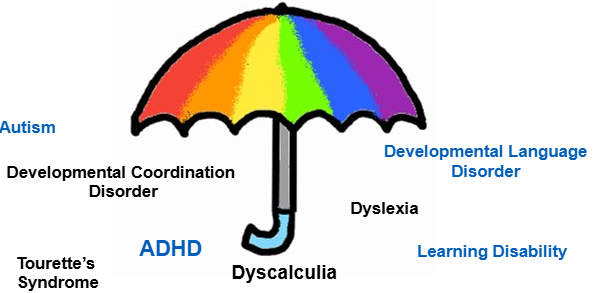
Please note that this is not a full list of neurodevelopmental diagnoses.
ADHD is a neurodevelopmental diagnosis. This means there are differences in the brain which affects how a person:
- interacts and communicates
- processes verbal, visual and sensory information
- develops and maintains relationships
- regulates their own emotions
-
makes sense of the world
-
responds to their environment
Having ADHD does not mean that the way your brain works is wrong, it is just different to a non-ADHD brain.
The exact causes of ADHD are unknown. We often see it run in families but there is not one gene that leads to someone having ADHD.
Statistics around how common ADHD is, are widely varied and this is likely because our understanding of ADHD continues to change, and more and more people are being diagnosed. In the UK, it is thought that around 737,197 children have a diagnosis of ADHD, although this is ever increasing.
People with ADHD will share similar qualities, and they will also have individual strengths and difficulties. ADHD is a large spectrum that includes a range of different skills and abilities. No one person with ADHD is the same!
There have been many studies looking into the brain structures of people with ADHD to try and understand more about the science behind ADHD.
However, from studies, there are no consistent findings on brain imaging of people with ADHD.
There are some differences that have been found in the brains of people with ADHD, such as some structures of the brain being smaller than people without ADHD, and some activity in certain parts of the brain being reduced.
One common theory is that people with ADHD have differences in the brain’s transmission of dopamine. There is some evidence from studies looking at brain imaging that back up this theory.
However, new research is being done all the time to understand more about ADHD and this will continue to change.
Some newer research has found that some people with ADHD have heightened connectivity between structures deep in the brain involved in learning, movement, reward, and emotion, and structures in the frontal area of the brain involved in attention and control of unwanted behaviours.
At present, the best way to assess young people for ADHD is through a full neurodevelopmental assessment. Understanding the young person’s presentation over the course of their childhood and how it impacts across settings through observations and reports.
If you look up ADHD online, you may see lots of information about the dopamine theory of ADHD.
Dopamine is known as the “feel-good” hormone. It gives you a sense of pleasure and it also gives you the motivation to do something when you’re feeling pleasure.
Dopamine is part of your reward system. As humans, our brains will often seek out behaviours that release dopamine in our reward system. When you’re doing something pleasurable, your brain releases a large amount of dopamine. You feel good and you seek more of that feeling.
The original dopamine theory of ADHD (1991) suggested that ADHD was caused by a reduction in dopamine function, resulting in less dopamine in the brain. Low dopamine levels can lead to:
- Tiredness
- Low motivation
- Sleep problems
- Difficulties concentrating
Therefore, people with ADHD can do activities that give the brain a boost of dopamine. It may be helpful to learn about activities that naturally boost dopamine levels to see if any of these may help you or your young person. Like:
- Exercise
- Getting enough sleep
- Listening to music
- Mediation
- Getting out in the sunlight
- Engaging in a hobby
- Eating something sweet
It is also important to note that later research has indicated that not all areas of the ADHD brain have less dopamine, and some areas may have more dopamine than expected.
Within our service, our assessments are guided by NICE guidelines and the DSM-5 diagnostic criteria. However, we are also led by current evidence and recognise that our understanding of ADHD is regularly changing.
NICE guidelines: NICE (National Institute for Health and Care Excellence) guidelines are evidence-based recommendations for health and care in England and Wales. Find out more here: www.
DSM-V: The DSM-5 (Diagnostic and Statistical Manual, fifth edition) is a manual that provides descriptions of the diagnostic criteria for a range of developmental, emotional and behavioural diagnoses.
We acknowledge that there are terms within the diagnostic criteria such as ‘fails to..’, ‘reluctant to engage’, ‘excessively’ and ‘intrudes on..’. This comes from the medical model of disability that sees differences as ‘abnormal’. As described in the previous pages, our understanding of ADHD has changed a lot in recent years. ADHD is now understood as simply being part of human diversity.
Whilst we do have to use diagnostic criteria when we are diagnosing ADHD, we have provided a different way of understanding this within the booklet.
In the diagnostic criteria, ADHD is characterised by key differences, which are broken down into the following areas:
1. Inattention
2. Hyperactivity and Impulsivity
Criteria 1: Inattention
Six (or more) of the following symptoms have persisted for at least 6 months to a degree that is inconsistent with developmental level and that negatively impacts directly on social, academic and occupational activities:
- Often fails to give close attention to details or makes careless mistakes in schoolwork, at work, or with other activities.
- Often has trouble holding attention on tasks or play activities.
- Often does not seem to listen when spoken to directly.
- Often does not follow through on instructions and fails to finish schoolwork, chores, or duties in the workplace (e.g., loses focus, side-tracked).
- Often has trouble organising tasks and activities.
- Often avoids, dislikes, or is reluctant to do tasks that require mental effort over a long period of time (such as schoolwork or homework).
- Often loses things necessary for tasks and activities (e.g. school materials, pencils, books, tools, wallets, keys, paperwork, eyeglasses, mobile telephones).
- Is often easily distracted.
- Is often forgetful in daily activities.
Criteria 2: Hyperactivity/Impulsivity
Six (or more) of the following symptoms have persisted for at least 6 months to a degree that is inconsistent with developmental level and that negatively impacts directly on social, academic and occupational activities:
- Often fidgets with or taps hands or feet, or squirms in seat.
-
Often leaves seat in situations when remaining seated is expected.
-
Often runs about or climbs in situations where it is not appropriate(adolescents or adults may be limited to feeling restless).
-
Often unable to play or take part in leisure activities quietly.
-
Is often “on the go” acting as if “driven by a motor.”
-
Often talks excessively.
-
Often blurts out an answer before a question has been completed.
-
Often has trouble waiting their turn.
-
Often interrupts or intrudes on others (e.g., butts into conversations or games).
Based on the types of symptoms that are reported and observed, 3 presentations of ADHD can occur:
1. Combined Presentation: if enough symptoms of both criteria in attention and hyperactivity-impulsivity were present for the past 6months
2. Predominantly Inattentive Presentation: if enough symptoms of inattention, but not hyperactivity-impulsivity, were present for the past six months
3. Predominantly Hyperactive-Impulsive Presentation: if enough symptoms of hyperactivity-impulsivity, but not inattention, were present for the past six months.
Within your young person’s report, it might not explicitly state which presentation of ADHD your young person has. If it does not say, it would be safe to assume that your young person likely has the combined presentation of ADHD with both signs of inattention and hyperactivity/impulsivity present.
Your young person’s report would likely state if your young person had received a Predominantly Inattentive Presentation or a Predominantly Hyperactive-Impulsive Presentation.
If you are in any doubt, you can ask your young person’s care coordinator.
ADHD is a pattern of differences, not just one or two of the things detailed on the previous page or the following pages. To have received a diagnosis of ADHD, there needs to be the presence of differences in attention regulation and/or the presence of hyperactivity and impulsivity.
The diagnostic report you received should identify your young person’s unique ADHD profile. Over the next two pages are examples of how differences might present in people with ADHD.
| Attention and organisation | Hyperactivity and impulsivity |
| People with ADHD may have a keenness to complete tasks quickly or may not process information fully which can lead to mistakes and missing details. | For some people with ADHD, they may seek high levels of movement and appear to have endless energy, despite not always getting a full night's sleep! |
| People with ADHD often have differences in how they regulate their attention. With something less motivating or interesting, they may find it much harder to focus their attention. However, if something takes their interest, they may be able to focus their attention for longer periods of time. | Some people with ADHD do not always present with observable hyperactivity and impulsivity. They may experience periods of little motivation and choice paralysis (difficulties initiating tasks and making choices). |
| People with ADHD may be described as “daydreamers” as they may regularly zone out even when being spoken to directly. | Some people with ADHD may experience more internal restlessness (a sense of wanting/needing to move) however will resist to follow rules. |
| People with ADHD may find it harder to organise themselves due to differences in executive functioning. They may have developed their own strategies to support with this, such as visual checklists and reminders. | People with ADHD may be described as “chatterboxes” and find it harder to engage in activities quietly. |
| People with ADHD can experience ‘hyperfocus’ where they can become very engrossed in a preferred activity of their choosing. | Some people with ADHD can fear that they will forget a thought or idea they get and so they may share it without always thinking about whether it is interrupting something. They also may have so many thoughts at once that they lose track of the conversation. |
| People with ADHD can experience ‘time blindness’ which is a difficulty sensing how much time has passed and estimating the time needed to get something done. | People with ADHD can experience their emotions intensely and may be more likely to react without thinking or engage in risk-taking behaviours when emotionally heightened. |
| People with ADHD may start new hobbies and become very passionate about them quickly but may find it hard to sustain their interest without becoming bored. | Children with ADHD may be more likely to run, climb and have little sense of danger but as they get older and more socially aware, they may be more internally restless and fidgety. |
| Paying attention and listening can be very tiring for people with ADHD, particularly when their activity needs are not being met. | People with ADHD can often develop their own strategies, such as requesting toilet breaks or volunteering for classroom jobs to give themselves movement breaks. |
| People with ADHD may have excellent memory for certain things but may present as forgetful of daily activities or their belongings. | People with ADHD may have lots of wonderful thoughts and ideas which they may share rapidly and out of context. |
The more we reframe ADHD behaviours, and what historically have been referred to as ‘deficits’ or ‘abnormal’ behaviours, as simply differences, the more we can change other peoples’ perceptions of ADHD. The evidence shows that supporting neurodivergent people to have a positive self-identity, leads to better outcomes for neurodivergent people.
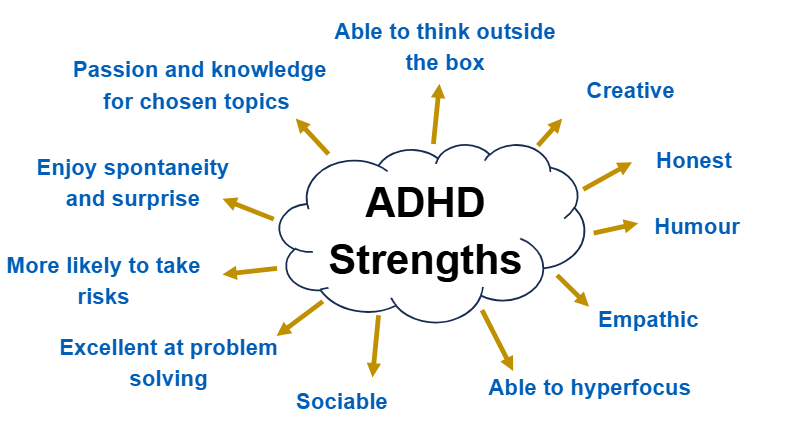
Sometimes it can be very easy to focus on the difficulties you and your young person might be experiencing. It can be important to take a step back and consider all the positives and strengths that your young person has. Like everyone, we all have our own individual skills and strengths, and once we recognise what these are, we can understand how to best use these to our advantage.
There are lots of strengths that can come from having ADHD. The diagram above shows common ADHD strengths, some of which may be true for your young person.
It is important to regularly remind and highlight strengths to young people to help promote a positive self-identity.
With our growing understanding of ADHD, we know that ADHD can present differently in everybody, and every person with ADHD has their own strengths and differences.
There is still a lot of work to be done around educating others, accepting difference and accommodating different brain types across work, health and education settings. Because of this, many people with ADHD mask or hide parts of their identity to fit in with those around them.
It is important to note that we all camouflage to some extent.
For example, many of you will likely have acted differently in a job interview to how you would usually present at home or with friends and family. However, we would often only do this for short periods or in specific situations.
When a person with ADHD internalises or camouflages some of their differences, it is often to hide parts of their ADHD identity. People with ADHD can camouflage in multiple settings and around different people.
When someone’s ADHD traits are not ‘obvious’ to other people or they are consciously or subconsciously hiding parts of themselves, then we might refer to their presentation as more ‘internalised’.
This internalised presentation, while more commonly seen in females, can also be seen across the gender spectrum.
There are many signs of ADHD that are experienced more internally rather than being observed externally. These are still ADHD traits experienced by others but may not be as commonly attributed to ADHD by those who do not have ADHD.
Some of these “hidden” ADHD symptoms often go unseen and therefore they can be misunderstood. Many of these symptoms are not stated within the diagnostic criteria for ADHD.
However, from research, these are some examples of “hidden” ADHD symptoms are:
-
emotional dysregulation
-
time blindness, or not being aware of time
-
racing thoughts
-
intrusive or self-defeating thoughts
-
overwhelm due to sensory sensitivities
-
sensitivity to criticism
-
social anxiety
-
difficulty making choices
-
sleep issues and disturbances
-
fatigue
-
restlessness
-
low self-esteem
-
guilt and shame
Camouflaging can be exhausting for people with ADHD, and research has shown that the more people camouflage, the greater the impact on their mental health and wellbeing.
There is ever growing research happening around ADHD and particularly how it can present in people at different ages and stages of their lives. Some concepts and topics that are beginning to be researched now are;
Rejection Sensitive Dysphoria and ADHD
Rejection Sensitive Dysphoria (RSD) is a term used to describe an intense emotional sensitivity to perceived or actual rejection, criticism, or failure, and there is suggestion that this can be associated with ADHD.
Interest-Based Nervous System vs Importance Based Nervous System
The "interest-based nervous system" is a concept that suggests how people with ADHD are motivated by tasks that are engaging, novel, and enjoyable, rather than solely by importance or external pressures.
Reward Systems and ADHD
There are suggestions that individuals with ADHD often show a preference for immediate rewards and struggle with delayed rewards (as might be promised with a reward system). Therefore, they might be less responsive to traditional reward charts.
These may be topics you want to look into yourself as there will continue to be research and information around these areas.
People with ADHD can experience sensory overload. Sensory processing differences occur when something overstimulates one or more of the senses.
Different stimuli can compete for attention, making it impossible for the brain to process the information it receives. When this happens, the person experiencing sensory overload may overreact to a situation by acting out or underreact by shutting down.
Did you know that we actually have eight sensory systems delivering information to our brain? You will likely know these five…

But there are also 3 other sensory systems that are not as well known about:
Interoception (internal)
This sensory input allows us to feel what is happening inside our body. It plays an important role in recognising when we are hungry, full, thirsty, too hot, too cold, nauseous and much more.
Proprioception (movement)
This sensory input is linked to our muscles, tendons, ligaments and joints. It tells us where our body is in space and helps us recognise and control force and pressure.
Vestibular (balance)
This sensory input helps us recognise any change in position, direction or movement of the head. This helps us stay balanced and coordinated.
The symptoms of sensory overload can vary widely. Depending on the person and situation, people may overreact, underreact, or react at unexpected times.
ADHD makes it difficult for many people to regulate their emotions. When people with ADHD become overstimulated, they may be unable to focus as environmental factors or sensations crowd their brains.
People with ADHD and sensory overload may be unable to quickly “switch gears” in terms of the activity in which they are taking part. They may find it challenging to register new stimuli or changes in their environment. This could lead to a feeling of being overwhelmed when something unexpected happens. After encountering a trigger, some people with sensory overload cannot function properly until their senses normalise again.
We recommend that you learn more about sensory processing and strategies you can use to support your young person. The Sensory Help website (detailed below) has lots of free courses and resources for parents and carers.
You may also want to explore the organisation below for more information on this topic:


ADHD is often associated with difficulties in executive functioning. Executive functioning refers to a set of skills that we need to be able to plan ahead, meet goals, display self-control and to stay focused. They are the thinking skills that we all need and use to complete everyday tasks.
There are 11 different executive functions that help us complete a task:
| Function | How it helps us |
| Response inhibition | The capacity to think before you act. |
| Working memory | The ability to hold information in mind for a short time and use this to respond to tasks (e.g. being given instructions) |
| Emotional control | The ability to manage emotions to achieve goals, complete tasks, or control behaviour. |
| Sustained attention | The capacity to maintain attention to a situation or task despite distractibility, fatigue or boredom. |
| Task inhibition | The ability to begin a task in a timely fashion. Knowing where to start and what to use. |
| Planning | The ability to create a plan to reach a goal or complete a task. |
| Organisation | The ability to design and maintain systems for keeping track of items, information and materials required for daily use. |
| Time management | The capacity to estimate how much time you have, and how to allocate this. |
| Goal directed persistence | The capacity to have a realistic goal, follow through to the completion and not be put off or distracted. |
| Flexibility | The ability to revise plans in the face of obstacles, setbacks, new information and mistakes. The ability to manage changing conditions and differing opinions. |
| Metacognition | The ability to stand back and reflect on a specific situation/problem. The ability to observe how you problem solve, including self- reflection. |
These can be delayed with development, or their performance may be affected by low mood, lack of sleep, life events. They all develop at different rates but won’t fully develop until 25 years old!
Your young person may have differences with some or all of these executive functions. To develop or support these skills, we need to think of how the brain works.
When learning new skills, connections are made in the brain. These start off weak and only become stronger with practice. Without these connections, we may struggle with completing tasks as messages become lost or delayed.
We need to experience different interactions with the environment, or we need to copy the adults in our life to start building these connections.
To learn more about this and strategies you can use to support your young person to develop these skills or manage their differences, you can sign up to a workshop in CYPS.
The workshop is called ‘Executive Functions – Building Blocks to Independence’.
You can sign up by speaking to your young person’s care coordinator, by telephone 0800 652 2864 or email NGCYPS
You may also want to explore some of the organisations below for more information on this topic:
www.bristolautismsupport.org/autism-and-executive-functioning/ 
www.youtube.com/watch?v=Fq8_CXWYSzw 
We know that many of your young people will experience sleep difficulties. Studies show that up to 70% of children with ADHD will experience sleep problems. The most common sleep problems are difficulties falling to sleep, poor sleep quality, broken sleep and sleeping for a shorter duration.
Sleep plays a vital role in good health and well-being throughout your life. The way you feel while you are awake depends in part on what happens while you are sleeping. During sleep, your body is working to support healthy brain function and maintain your physical health.
To learn more about sleep, the connection between ADHD and sleep, and ideas to support your young person’s sleep, you can watch this recorded webinar developed by Sleep Action.

You may also want to explore some of the organisations below for more information on this topic:


We are very aware that a lot of people with ADHD can find school or college a challenging and anxiety inducing place. There are many reasons why this might be the case. Some of these reasons are suggested below:
- The school environment and everything that occurs in the school day is not always designed to meet the needs of people with ADHD. Whilst we know that schools will try their best to adapt the environment for students with ADHD, we know that traditional teaching methods do not always consider the thinking and learning styles of people with ADHD.
- Some people with ADHD can be motivated by novel experiences and need to be interested to sustain their attention and complete tasks. For a lot of people with ADHD, there are elements of school which not suit this thinking and learning style.
- Teachers are often busy and working under pressure or may not always be given information about individual students and accommodations that need to be made. Teachers may not always have received training around supporting neurodivergent students.
Every young person is entitled to an education and reasonable adjustments to accommodate their specific strengths and difficulties. It is important to know your young person’s rights and how to best approach educational concerns.
These services have resources for families and advice lines you can contact for support:
-
www.newcastlesendiass.co.uk (Local support)

-
www.gatesheadsendiass.org.uk (Local support)

-
www.ipsea.org.uk (National support)

-
www.notfineinschool.co.uk (Online information)

Just because you now know that your young person has ADHD, this does not mean you have to change anything you are already doing to support them, and it does not mean that you do not know your young person anymore.
Remember that you are still the expert of your young person, you likely know them best! Also remember that your young person has always had ADHD. Therefore, you have always been supporting and loving a person with ADHD.
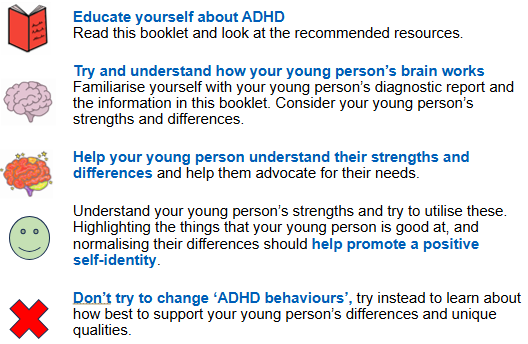
Some suggestions of things you can do now are:
You may be wondering:
“Are there medications that can help my young person?”
Yes, some symptoms of ADHD can be managed using medication or behavioural strategies, but a combination of both is often considered most effective.
We will provide you with brief information about ADHD medication here, but the best way to learn about medication options is when you meet the prescriber in CYPS for a medication appointment if this is something you have chosen to explore.
There are two main types of medication licensed for the treatment of ADHD:
1. Stimulant medications work by increasing activity in the brain, particularly in areas that play a part in regulating attention and behaviour. These are the most commonly used form of medication and come in short and long-acting formulations.
2. Non-stimulant medications work in a different way. These often take more time to work but may have a longer duration of effect.
Everyone will respond to ADHD medication differently.
Should your young person be started on ADHD medication within CYPS, this will be monitored closely, and medication doses will be adapted according to how your young person responds.
We know that from research:
- Having a positive self-identity can lead to better outcomes for neurodivergent people
- Knowing you have ADHD and how your brain works earlier can lead to better outcomes for people with ADHD
Therefore, this suggests that sharing an ADHD diagnosis with your young person is important for their self-identify and future. However, there is no ‘right’ way of doing this. We are also aware that you might still need time to process this diagnosis yourself first, this is okay.
Below are some tips from the National Autistic Society website at www.
- Who is the best person to help bring up the subject?
- Choose a moment when you're both in a calm mood and in a familiar place where you both feel comfortable.
- Utilise strategies to best support your young person’s attention and listening, i.e. fidget toys, visuals etc.
- Consider having something written to give your young person to help them process and retain information shared.
- Try to make sure you won't be interrupted.
- Reflect on your own strengths and differences.
- Help them relate to people they know with ADHD, reflect on family members or classmates who they may share similarities with.
Primary school:
|
Let’s talk about ADHD |
  |
|
That’s Me, I have ADHD! |
 |
|
What is ADHD? |
 |
|
The Abilities in Me: ADHD |
 |
Secondary school:
|
Learn about neurodiversity |
  |
|
ADHD and You https://adhdandyou.co.uk/young-person/what-adhd-young-person |
 |
|
Unmasked |
 |
|
Wonderfully wired brains |
 |
|
The ADHD Teen Survival Guide www.amazon.co.uk/ADHD-Teen-Survival-Guide-Launchpad/dp/1839976632 |
 |
Young adult:
|
Unmasked |
|
|
ADHD in women |
 |
|
Failing at Normal: An ADHD Success Story |
 |
|
Your Brain’s Not Broken www.amazon.co.uk/Your-Brains-Not-Broken-Strategies/dp/0800739426 |
 |
|
ADHD Resources |
 |
“There is comfort in knowing you are a normal zebra, not a strange horse. You can’t find community with other zebras if you don’t know you belong. And it is impossible for a zebra to be happy or healthy spending its life feeling like a failed horse.”
Quote taken from ‘Neurodivergence: seeing the whole picture’, Community Practitioner 2024
Your mornings are always so stressful,
You've got us kids to get to school.
Why do you have to repeat yourself
Am I deliberately acting the fool?
You're trying to teach the class,
There's so much to get through.
There I am daydreaming,
You bet I won't know what to do!
I've interrupted again,
I wish I could wait my turn.
I can see the frustration in your eyes,
My cheeks begin to burn.
I'm trying to sit still and listen,
But my thoughts are so very loud.
I tap my pen, wiggle in my chair,
Your face begins to cloud.
You see, I already know all of this,
I can see it makes you mad.
I try my best to change,
I try not to be bad.
But let's take a look at all the good,
That comes from my ADHD.
All these traits, all these quirks
They're what make me, me!
My brain is like a race car,
Except it has bicycle brakes
But give me a problem to solve,
You'll be amazed how little time it takes.
My passion for my latest hobby,
It's really clear to see.
I'll probably have moved on tomorrow,
Yep... That’s ADHD!
I'm great at motivating others,
My enthusiasm is infectious.
When I'm passionate about something,
The amount I can focus is endless.
I'm empathetic, fiercely loyal,
My sense of justice is strong.
I love to talk, I love to laugh,
We could really get along!
So, next time I am frustrating you
Take a second to really see me.
And help me to see my positives,
As I grow with ADHD.
Written by Gemma Cullen.
A colleague with ADHD in the Neurodevelopmental Team, CYPS.
| Support | What they offer | Contact details |
 |
Pathways 4 All is a parent-led charity, providing play and leisure services for disabled children and young people, situated at the Tim Lamb Children’s Centre. |
Telephone: 0191 266 5233 Email: info@pathways4all.co.uk Website: www.pathways4all.co.uk |
 |
Skills for People work to help disabled people and their families control their own lives and feel included in the communities of their choice. |
Telephone: 0191 281 8737 Website: www.skillsforpeople.org.uk |
 |
Daisy Chain is a registered charity supporting and empowering autistic and neurodivergent individuals. They run Gateshead Autism Hubs and offer workshops and virtual support sessions. |
Telephone: 01642 531 248 Email: info@daisychainproject.co.uk |
 |
Disability North is a registered charity promoting inclusion, independence and choice for disabled people and their families. They have lots of information on their website around entitlements and support. |
Telephone: 0191 284 0480 Email:reception@disabilitynorth.org.uk Website: www.disabilitynorth.org.uk/ |
 |
Family Lives: free helpline for parents/ carers for emotional support, information, advice and guidance on any aspect of parenting and family life. |
Telephone: 0808 800 2222 Email: askus@familylives.org.uk Website: www.familylives.org.uk |
 |
Gateshead Family Hubs support families of children from 0-25 who have special educational needs and disabilities. There are nine family hubs located across Gateshead. Ask about their Parents Plus ADHD programme for parents of children aged 6-12 with ADHD. | www.gateshead.gov.uk/article/22551/Gateshead-Family-Hubs  |
 |
Children and Families Newcastle help ensure services and support is accessible to children and families. There are Community Hubs across the city which are shaped by the local communities. Check the website for the telephone number for your local community hub. |
www.newcastle.gov.uk/services/ care-and-support/children/getting-help-children-and-families/children-families-newcastle |
 |
The role of the 0-19 Growing Healthy Team in Gateshead is to protect and promote the health and wellbeing of children and young people. |
Telephone: 0303 003 1918 Email: spoc.hdftgateshead@nhs.net |


| Support | What they offer | Contact details |
 |
Pass It On Parents support families from Newcastle who have children with additional needs. It is a safe place to seek advice and to support other parent/ carers. | www.facebook.com/groups/137546439656628  |
 |
Little Treasures is a north east registered charity supporting adults and children who are autistic and neurodivergent. |
Email: littletreasures18@gmail.com Website: www.littletreasures.org.uk |
 |
Access a program of parent workshops on a range of different topics. | www.nsft.nhs.uk/parent-workshops  |
 |
Sign up to access a range of different online learning courses on relevant topics, including neurodivergence and mental health. |
www.recoverycollegeonline.co.uk |
 |
Gateshead Parent Carer Forum is an organised volunteer group of parents and carers of disabled children and young people who have a variety of special educational needs and disabilities living across the Gateshead borough. |
www.gatesheadparentcarerforum.co.uk |
 |
ADHD UK is by people with ADHD for people with ADHD. | https://adhduk.co.uk  |
 |
For parents and carers of children and young people with special educational needs to attend live and pre-recorded webinars on a range of topics. |
advice-and-support/events-and-webinars |
 |
Adult ADHD Support Group in the North East with meetings in Newcastle and Gateshead. These are informal gatherings that focus on sharing personal experiences with ADHD). To find out the dates and locations of this support group, look on their website. |
https://aadhd-ne-uk.weebly.com |


If your young person is still open to CYPS, then any queries relating to your young person’s care can be directed to the CYPS Duty Team:
CYPS Duty Team
Telephone: 0800 652 2864
Email: NGCYPS
Single Point of Access
Telephone: 0303 123 1147
If your young person has been discharged from CYPS and you think they would benefit from a new referral, you can call the number above to make a new referral.
The Universal Crisis Team
Telephone: NHS 111 and select the mental health option 2
If you ever feel your young person is in a Mental Health Crisis, then you can contact the Universal Crisis Team. The Universal Crisis Team operates 24 hours a day, seven days a week. Your young person does not need an open CYPS referral to access this support.
Mental health is as important as physical health. You will not be wasting anyone's time.
Emergency or you need urgent help
If you or someone else is in danger, call 999 or go to A&E immediately
If you want to make a comment, suggestion, compliment or complaint you can:
- Talk to the people directly involved in your care
- Ask a member of staff for a feedback form, or complete a form on the Trust website www.
cntw.nhs.uk/ contact/ complaints/ - Telephone the Complaints Department Telephone: 0191 245 6672
- Email complaints
@cntw.nhs.uk
We are always looking at ways to improve services. Your feedback allows us to monitor the quality of our services and act upon issues that you bring to our attention.
You can provide feedback in the following ways:
- the quickest way for you to do this is to complete our short online survey at www.
- complete a Your Voice survey, available on wards, reception areas or from staff
- other options for sharing your feedback and experience www.
Patient Advice and Liaison Service (PALS)
PALS provide confidential advice and support, helping you to sort out any concerns that you may have about any aspect of your or your loved ones care.
We act independently when handling patient and family concerns, liaising with staff, managers and, where appropriate, relevant organisations, to negotiate prompt solutions. If necessary, we can also refer patients and families to specific local or national-based support agencies.
North of Tyne
Telephone: 0800 032 0202
Email: pals
Post: FREEPOST PALS
South of Tyne
Telephone: 0800 328 4397
Text: 07825 061 035
Email: pals
Post: Patient Advice and Liaison Service, Garden Lodge, Hopewood Park, Ryhope, Sunderland, SR2 0NB
9am – 4.30 pm, Monday to Friday
An answerphone is available at all times for you to leave a message. A member of the PALS team will aim to return your call as soon as possible.
PALS North of Tyne
Telephone: 0800 032 0202
Email: pals
Post: FREEPOST PALS
PALS South of Tyne
Telephone: 0800 328 4397
Text: 07825 061 035
Email: pals
Post: Patient Advice and Liaison Service, Garden Lodge, Hopewood Park,Ryhope, Sunderland, SR2 0NB
9am to 4.30 pm, Monday to Friday
An answerphone is always available for you to leave a message. A member of the PALS team will aim to return your call as soon as possible.
Further information about the content, reference sources or production of this leaflet can be obtained from the Patient Information Centre. If you would like to tell us what you think about this leaflet please get in touch.
This information can be made available in a range of formats on request (eg Braille, audio, larger print, easy read, BSL or other languages). Please contact the Patient Information Centre on telephone 0191 246 7288
Published by the Patient Information Centre
2025 Copyright: Cumbria, Northumberland, Tyne and Wear NHS Foundation Trust
Ref: PIC/924/0125 January 2025 V1
Website: www.
Telephone: 0191 246 7288
Review date 2029
Find us on social media, search for CNTW