
A booklet from the Newcastle and Gateshead Children and Young Peoples service which provides post-diagnostic information and signposting for parents/carers after their child/young person has received an autism diagnosis through the service.
This file may not be suitable for assistive technology. If you use assistive technology (such as a screen reader) and need a version of this document in a more accessible format. Please email pic

Dear Parent/ Carer,
Your young person has likely just received a diagnosis of Autism Spectrum Disorder following an assessment with our team. You may hear this diagnosis being referred to as ‘Autism’, ‘ASD’, or ‘ASC’.
Autism Spectrum Disorder (ASD) is the diagnostic term outlined within the DSM-5, which is the medical diagnostic manual we use when making a diagnosis. This will be explained in more detail later, on pages 7 and 8.
Within this booklet, we will use identity-first language and therefore we will say ‘autistic person’ rather than ‘person with autism’. This is the preferred language of the autistic community; however, we acknowledge that every young person may have their own personal preference. This booklet has been produced and reviewed by members of the neurodevelopmental team, many of whom have their own lived experience of neurodivergence.
The booklet has also been reviewed and adapted by parents of autistic adults and children. We know that many of you will have waited a long time to access an autism assessment and you may have feelings of frustration about this. For some of you an autism diagnosis may have come with feelings of relief and validation. For others, it may have been difficult to hear and understand.
We understand that reading through this booklet may also cause you to feel
lots of different emotions. Please read through it in your own time and take
breaks between reading. We hope that the information and resources in this
booklet help you at whatever stage of the journey you are on.
Yours sincerely,
The Neurodevelopmental Team
To understand more about autism, we want to introduce you to a few different
terms. Some of these terms you may have heard of, and others you may not
have.
Understanding more about these terms will help you understand more about
our current understanding of autism and should help you advocate for your
young person’s needs.
Neurodiversity
Neurodiversity is used to explain the normal differences in
brain types and behaviour. It supports the idea that no two
brains are the same. Differences are normal!
We all have different ways that we experience and interact with the world.
Neurodiversity can be broken down into two categories of people:
- Neurotypical
Neurotypical people are seen as people whose brain works in a way that is seen to be ‘standard’.
- Neurodivergent
Neurodivergent people are seen as people whose brain works in a different way to the ‘standard’.
An estimated 15-20% of people are neurodivergent! This shows us that neurodivergence is just part of human evolution. Diversity of minds, intelligences, abilities, and differences are just part of being human. Some examples of diagnoses that neurodivergent people might have, are shown below. As you can see autism comes under this umbrella term. Neurodivergent people may have one or more of the diagnoses shown below:
- Autism
- ADHD
- Tourette’s Syndrome
- Developmental Language Disorder
- Developmental Coordination Disorder
- Dyslexia
- Dyscalculia
- Learning Disability
Autism is a neurodevelopmental diagnosis. This means there are differences in the brain which affects how a person:
• interacts and communicates
• processes verbal, visual and sensory information
• develops relationships
• responds to their own and others’ emotions
• makes sense of the world
Being autistic does not mean that the way your brain works is wrong, it is just different to a non-autistic person’s brain. The exact causes of autism are unknown. We often see it run in families but there is not one gene that leads to someone being autistic. More than 1 in 100 people are autistic and, in the UK, around 700,000 people are autistic. Autistic people will share similar qualities, and they will also have individual strengths and difficulties. Autism is a large spectrum that includes a range of different skills and abilities. No one autistic person is the same!
Sometimes people imagine the autism spectrum as a line going from “less autistic” to “more autistic.” In reality, it is more helpful to think of autism as a profile of differences across different areas such as:
-
Communication
-
Focus
-
Sensory experiences
-
Flexibility and routines
-
Social interaction
Each autistic person will have their own unique combination of strengths and differences.
Within our service, autism assessments are guided by NICE guidelines and the DSM-5 diagnostic criteria. However, we are also guided by current research and evidence, recognising that our understanding of autism continues to develop and change over time.
NICE Guidelines
NICE (National Institute for Health and Care Excellence) provides evidence-based recommendations for health and care services in England and Wales. These guidelines help ensure assessments and support are delivered consistently and based on the best available evidence.
DSM-5
The DSM-5 (Diagnostic and Statistical Manual of Mental Disorders, Fifth Edition) is a manual used by healthcare professionals to describe the diagnostic criteria for a range of developmental, emotional and behavioural conditions.
We acknowledge that some terms used within the diagnostic criteria, such as “disorder” or “abnormal”, come from the medical model of disability, which historically viewed differences as deficits.
Our understanding of autism has changed significantly in recent years. Autism is now widely understood as part of human diversity, rather than something that needs to be “fixed”.
However, healthcare professionals are still required to use diagnostic criteria when making a diagnosis. The criteria identify key differences that fall into two main areas:
Social communication
Repetitive behaviours and interests
These are explained in more detail below:
Social communication
A1. Deficits in social emotional reciprocity
Reciprocity involves being able to see the world from another person’s point of view, show interest in others, and respond to the social and emotional cues of others.
A2. Deficits in nonverbal communication used for social interaction
This refers to differences in non-verbal communication. This is about using and understanding information through eye contact, facial expressions, gestures and body language.
A3. Deficits in developing, maintaining and understanding relationships
This refers to differences in making, keeping and understanding relationships. This is about how a person forms connections with people and develops meaningful relationships.
Repetitive behaviours and interests
B1. Stereotyped or repetitive motor movements, use of objects, or speech. This might be the presence of behaviours that are repetitive or unique, including body movements, speech or use of objects.
B2. Insistence in sameness, adherence to routine, ritualised patterns of behaviour. This is about how flexible or fixed someone is in their thoughts, behaviours and routines.
B3. Highly restricted, fixated interests that are abnormal in intensity or focus. This refers to a person having a pattern of becoming highly focussed and passionate about specific interests which may come into various areas of their life.
B4. Hyper- or hypo reactivity to sensory input or unusual sensory interests. This includes being under or over sensitive to the sound, touch, sight, smell and taste of different things.
Autism is a pattern of differences, not just one or two of the things detailed on the previous page or the following pages. To have received a diagnosis of autism, there needs to be the presence of differences in social, communication and the presence of repetitive behaviours and interests.
The diagnostic report you received should identify your young person’s unique autism profile. Over the next two pages are examples of how differences might present in autistic people.
Social Communication
- Autistic people can become skilled in understanding how non-autistic people communicate and interact.
- Autistic people can be very loyal and thoughtful friends. It may take longer for them to find people who they connect with.
- Autistic people can have more successful interactions with other autistic or neurodivergent people due to a mutual understanding around how to interact.
- Many autistic people can be socially motivated but may have less social energy than others. This means they may need more time after being with others to reenergise.
- Autistic people can prefer deeper conversations rather than small talk. They may feel more comfortable talking about their own topics of interests.
- Many autistic people have a more direct communication style which can lead to more genuine and honest interactions.
Many autistic people have learnt what might be expected of them with non-verbal communication by observing others or repeatedly being told to give eyecontact. For many autistic people this does not come naturally to them andbeing aware of others’ expectations can take up a lot of energy and focus.
Repetitive behaviours and interests
Examples
Autistic people can engage in “stims” (i.e. repetitive movements of the hands and fingers) that are unique to them. These behaviours can be very important to an autistic person as they can find these comforting, calming and enjoyable.
Autistic people can be very sensitive to sound or visual information. This means that they might be excellent at spotting patterns, noticing small details and hearing sounds that others cannot.
Autistic people can have the ability to follow a consistent routine repeatedly without getting bored. Routines can be very important to autistic people.
The sensory environment, e.g. how loud or busy a setting is, can impact on autistic people’s attention, engagement and emotions.
Changes to routine can be confusing and distressing for autistic people. New environments may also be overwhelming for an autistic person.
Autistic people can have an intense curiosity that inspires a deep desire to learn, focus and understand a specific topic. Autistic people can become highly skilled and knowledgeable in topics of their interest.
Autistic people can have a logical way of viewing and understanding the worldand therefore can offer factual and rational solutions to problems.
The more we reframe autistic behaviours, and what historically have beenreferred to as ‘deficits’ or ‘abnormal’ behaviours, as simply differences, themore we can change other peoples’ perceptions of autism. The evidence shows that supporting autistic people to have a positiveautistic identity, leads to better mental health outcomes for autisticpeople.
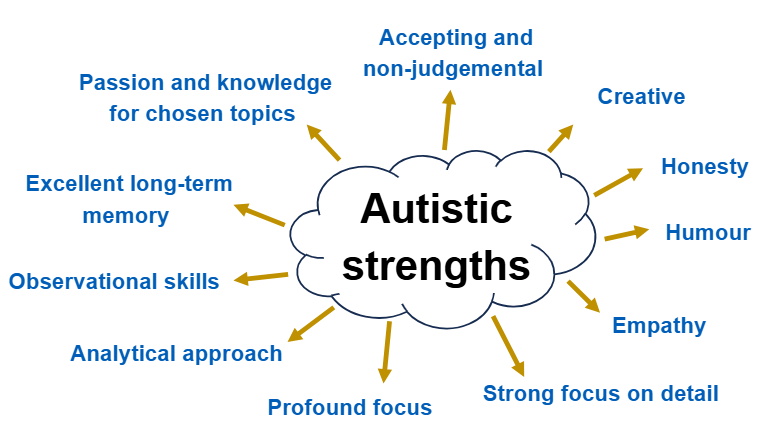
Sometimes it can be very easy to focus on the difficulties you and your autistic young person might be experiencing. It can be important to take a step back and consider all the positives and strengths that your young person has.
Like everyone, we all have our own individual skills and strengths, and once we recognise what these are, we can understand how to best use these to our advantage.
There are lots of strengths that can come from being autistic. The diagram above shows common autistic strengths, some of which may be true for your young person.
It is important to regularly remind and highlight strengths to young people to help promote a positive self-identity.
After thinking about strengths, we do not want to lessen the difficulties that lots of autistic people face. We know that many of you will have sought a referral or diagnosis because your young person was facing challenges in aspects of their life.
For a long time, the view has been that the autistic person has the ‘challenges’ and therefore the focus of support has been on changing the autistic person to fit in with other people’s standards.
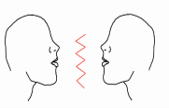
However, the Double Empathy Problem reframes the ‘challenges’ as happening when there is a mutual misunderstanding between autistic and non-autistic people.
Because autistic and non-autistic communication, interactions and behaviours can be quite different, the double empathy problem suggests that autistic and non-autistic people can struggle to empathise with each other.
This is because they have different ways of experiencing the world. This theory would also suggest that those with similar experiences are more likely to form connections and a level of understanding.
| Neurotypical | Autistic |
|
I may…
|
I may…
|
Social interactions are bidirectional or ‘two-way’. Understanding another person’s interaction and communication style is not just the responsibility of autistic people.
We often see that autistic people can gravitate towards other people with similar experiences and interaction styles. However, this does not mean that autistic and non-autistic people cannot get on or be good friends.
Ideally, we all need to learn about, accept and embrace everyone’s individual communication and interaction styles.
With our growing understanding of autism, we know that autism can present differently in everybody, and every autistic person has their own profile of strengths and differences.
There is still a lot of work to be done around educating others, accepting difference and accommodating different brain types across work, health and education settings. Because of this, many autistic people camouflage, mask or cover up parts of their identity to fit in with those around them.
It is important to note that we all camouflage to some extent.
For example, many of you will likely have acted differently in a job interview to how you would usually present at home or with friends and family. However, we would often only do this for short periods or in specific situations.
When an autistic person internalises or camouflages some of their differences, it is often to hide parts of their autistic identity. Autistic people can camouflage in multiple settings and around different people. 
When someone’s autistic traits are not ‘obvious’ to other people or they are hiding parts of themselves, then we might refer to their presentation as more ‘internalised’.
This internalised presentation, while more commonly seen in females, can also be seen across the gender spectrum.
The table below gives examples of the different types of camouflaging that an autistic person might use. Some autistic people are not always aware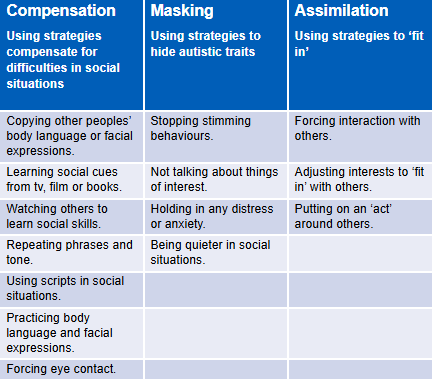
Camouflaging can be exhausting for autistic people, and research has shown that the more autistic people camouflage, the greater the impact on their mental health and wellbeing.
Processing everyday sensory information can be difficult for autistic people. Any of their senses may be over or under sensitive, or both, at different times. These sensory differences can affect how they feel and act and can have a big effect on a person’s life.
Did you know that we actually have 8 sensory systems delivering information to our brain? You will likely know these five…

But there are also 3 other sensory systems that are not as well known about:
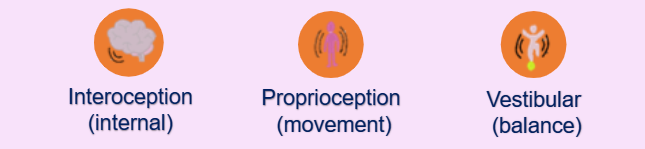
Interoception (internal)
This sensory input allows us to feel what is happening inside our body. It plays an important role in recognising when we are hungry, full, thirsty, too hot, too cold, nauseous and much more.
Proprioception (movement)
This sensory input is linked to our muscles, tendons, ligaments and joints. It tells us where our body is in space and helps us recognise and control force and pressure.
Vestibular (balance)
This sensory in put helps us recognise any change in position, direction or movement of the head. This helps us stay balanced and coordinated.
Autistic people may experience differences in how they recognise and respond to input from their senses. Sensory perceptions can become frightening, painful and can lead to high anxiety and emotional outbursts. You might see your young person experiencing a “meltdown” or a “shutdown” in response to sensory input.
Sensory systems can often be overwhelmed or under responsive which can lead autistic people to seek out sensory input and/or want to reduce sensory input. The sensory system is very complex, and every autistic person will have different sensory needs. Sensory needs can also vary depending on the setting and the person’s arousal levels.
We recommend that you learn more about sensory processing and strategies you can use to support your young person. You can sign up to a course on ‘Understanding Sensory Processing and Integration in Children’ by speaking to your young person’s care coordinator, phoning 0800 652 2864 or emailing NGCYPS
You may also want to explore some of the organisations below for more information on this topic.
-
www.
autism.org.uk/ advice-and-guidance/ topics/ sensory-differences/ sensory-differences/ all-audiences 


Executive Functioning refers to a set of skills that we need to be able to plan ahead, meet goals, display self-control and to stay focused. They are the thinking skills that we all need and use to complete everyday tasks.
There are 11 different executive functions that all work together to help us complete a task.
| Function | What they do |
| Response inhibition | The capacity to think before you act. |
| Working memory | The ability to hold information in mind for a short time and use this to respond to tasks (e.g. being given instructions) |
| Emotional control | The ability to manage emotions to achieve goals, complete tasks, or control behaviour. |
| Sustained attention | The capacity to maintain attention to a situation or task despite distractibility, fatigue or boredom. |
| Task inhibition | The ability to begin a task in a timely fashion. Knowing where to start and what to use. |
| Planning | The ability to create a plan to reach a goal or complete a task. |
| Organisation | The ability to design and maintain systems for keeping track of items, information and materials required for daily use. |
| Time management | The capacity to estimate how much time you have, and how to allocate this. |
| Goal directed persistence | The capacity to have a realistic goal, follow through to the completion and not be put off or distracted. |
| Flexibility | The ability to revise plans in the face of obstacles, setbacks, new information and mistakes. The ability to manage changing conditions and differing opinions. |
| Metacognition | The ability to stand back and reflect on a specific situation / problem. The ability to observe how you problem solve, including self- reflection. |
These can be delayed with development, or their performance may be affected by low mood, lack of sleep, life events. They all develop at different rates but won’t fully develop until 25 years old!
Your young person may have differences with some or all of these executive functions. To develop or support these skills, we need to think of how the brain works.
When learning new skills, connections are made in the brain. These start off weak and only become stronger with practice. Without these connections, we may struggle with completing tasks as messages become lost or delayed.
We need to experience different interactions with the environment, or we need to copy the adults in our life to start building these connections.
To learn more about this and strategies you can use to support your young person to develop these skills or manage their differences, you can sign up to a workshop in CYPS.
The workshop is called ‘Executive Functions – Building Blocks to Independence’.
You can sign up by speaking to your young person’s care coordinator, by phone 0800 652 2864 or email NGCYPS
You may also want to explore some of the organisations below for more information on this topic:


Everyone learns how to talk about, understand and control their emotions differently. Your young person may find regulating their emotions difficult, leading to ‘shutdowns’ or ‘meltdowns.’
This could be because they do not fully understand what emotions are and what they feel like. It could also be due to them keeping their emotions bottled up as they do not know how to express themselves.
We understand that some autistic people experience alexithymia. This word describes the experience of not being able to recognise or describe your own emotions. This means that it can be very difficult for some autistic people to talk about how they are feeling, recognise triggers and put strategies into
practise.
Autistic people can feel their emotions deeply and can feel like their emotions are out of control.
Some people have found the following helpful to support regulation when there are signs that a young person may be anxious or becoming dysregulated.
1. Breathing exercises 
- Breathe in for four seconds
- Hold for four seconds
- Breathe out for four seconds
- Hold for four seconds
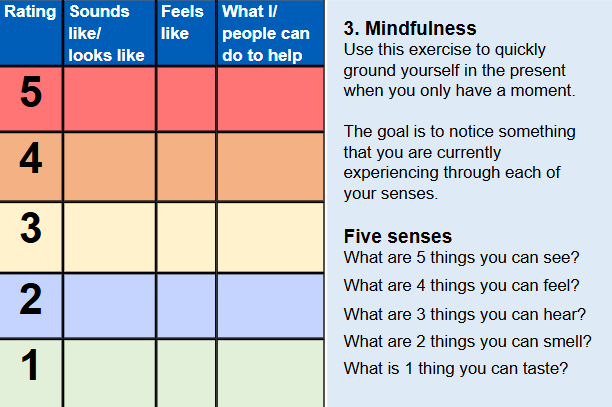
2. Five Point Scale
This helps your young person identify the physical sensations in the body when feeling a certain emotion (for example heart beating fast, sweating);what they look like (red face, become louder); what they can do to help (go for a walk, listen to music) and what others can do to help (give them a cuddle, give them space).
Explore some of the resources below for more information on this topic:


We are very aware that a lot of autistic people can find school or college achallenging and anxiety inducing place. There are many reasons why this might be the case. Some of these reasons are suggested below:
- The school environment and everything that occurs in the school day is not always designed to meet the needs of autistic people. Whilst we know that schools will try their best to adapt the environment for autistic students, we know that traditional teaching methods do not always consider the sensory and social needs or thinking and learning styles of autistic people.
- We know that some autistic people can be driven by success and complying with expectations and find it hard to communicate their needs and feelings and therefore may be more likely to mask their anxieties and feelings within the school setting. School can be a busy, unpredictable place with high amounts of social and academic pressure.
- Teachers are often busy and working under pressure or may not always be given information about individual students and accommodations that need to be made. Teachers may not always have received training around supporting neurodivergent students.
Every young person is entitled to an education and reasonable adjustments to accommodate their specific strengths and difficulties. It is important to know your young person’s rights and how to best approach educational concerns.
These services have resources for families and advice lines you can contact for support:


Now what?
Just because you now know that your young person is autistic, this does not mean you have to change anything you are already doing to support them, and it does not mean that you do not know your young person anymore.
Remember that you are still the expert of your young person, you likely know them best! Also remember that your young person has always been autistic. Therefore, you have always been supporting and loving an autistic person.
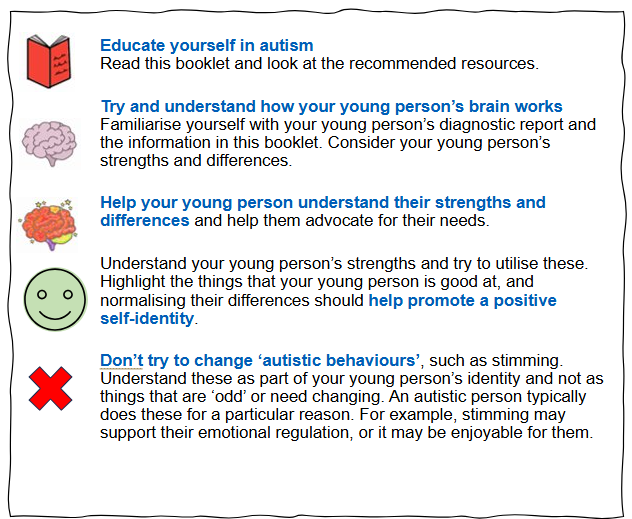
Some suggestions of things you can do now are:
We know that from research:
- Having a positive autistic identity can lead to better outcomes for autistic people
- Knowing you are autistic earlier can lead to better outcomes for autistic people
Therefore, this suggests that sharing an autism diagnosis with your young person is important for their self-identify and future. However, there is no ‘right’ way of doing this. We are also aware that you might still need time to process this diagnosis yourself first, this is okay.
Below are some tips from the National Autistic Society website at www.autism.org.uk on how to share a diagnosis:
- Who is the best person to help bring up the subject? If your young person is comfortable with a grandparent or aunt, it might be a good idea to get them involved too.
- Choose a moment when you're both in a calm mood and in a familiar place where you both feel comfortable. Autistic people can find it difficult to process new information, especially if they're feeling anxious, stressed or are in an unfamiliar environment.
- Try to make sure you won't be interrupted. Your young person may need time to think about what you're saying or to ask questions.
- One of the ways some parents start a conversation about autism is to talk first about differences. For example, you could write a list of family members' strengths and weaknesses, then talk about what your young person is good at and what they find difficult. You could point out that there is a name to this particular pattern of strengths and weaknesses.
- Your young person may have met other autistic people. You could explain that although autistic people have some things in common, they are all different.
Here are some recommendations on videos, books and websites that may be helpful to share with your young person:
| Primary School: | ||
|
Amazing Things Happen! |
 |
 |
|
Amazing Kids – Autism Spectrum Condition |
 |
|
|
The Neuro Bears |
 |
|
|
The Abilities in Me: Autism |
 |
|
|
The Superhero Brain |
 |
|
|
Autism and me |
 |
|
|
Amazing Me, Amazing You |
 |
| Secondary School: | ||
|
Young people explain autism |
 |
|
| Autistic children explain autism in 60 secondshttps://youtu.be/hU8xEH5yRnA |  |
|
|
Can you see me? |
 |
|
|
Autism Identity and Me |
 |
|
|
The Awesome Autistic Go-to-guide |
 |
|
|
Wonderfully wired brains |
 |
|
|
Understanding yourself |
 |
| Young Adult: | ||
|
Autistic Girls Network |
 |
|
|
Autism: A Guide for Young Peoplewww.sign.ac.uk/media/1159/pat145_young_people- |
 |
|
|
Ambitious about Autismwww.ambitiousaboutautism.org.uk/understanding-autism/preparing-for-adulthood/making-sense-of-your-autism- |
 |
|
|
Your Autism Diagnosis |
 |
|
|
Autism TED Talk |
 |
|
|
Autism Youth Network www.ambitiousaboutautism.org.uk/what-we-do/connecting-young-people/online-youth-network |
 |
|
|
Unmasked |
 |
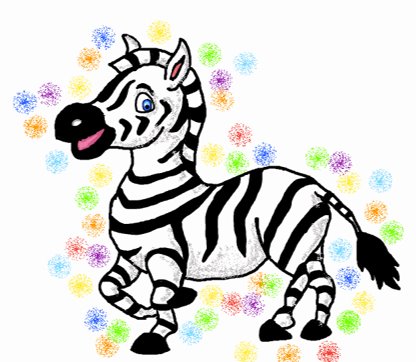
“There is comfort in knowing you are a normal zebra, not a strange horse. You can’t find community with other zebras if you don’t know you belong. And it is impossible for a zebra to be happy or healthy spending its life feeling like a failed horse.”
Some recommendations for sources of support locally:
| Support | What they offer | Contact details |
 |
North East Autism Society is a registered autism charity supporting parents/carers and autistic children/adults. They have online information, webinars and run Autism hubs across Newcastle. |
Telephone: Email: info Website: www.ne-as.org.uk |
 |
The Toby Henderson Trust is a registered autism charity supporting parents/carers and autistic children/adults. They have online information, webinars and a specialist family support service. |
Telephone: 0300 365 3055 Email: support Website: www.ttht.co.uk |
 |
Daisy Chain is a registered charity supporting and empowering autistic and neurodivergent individuals. They run Gateshead Autism Hubs and offer workshops and virtual support sessions. |
Telephone: 01642 531 248 Email: info Website:www.daisychainproject.co.uk |
 |
Disability North is a registered charity promoting inclusion, independence and choice for disabled people and their families. They have lots of information on their website around entitlements and support. |
Telephone: 0191 284 0480 Email:reception Website: www.disabilitynorth.org.uk |


| Support | What they offer | Contact details |
 |
Pathways 4 All is a parent-led charity, providing play and leisure services for disabled children and young people, situated at the Tim Lamb Children’s Centre. |
Telephone: 0191 266 5233 Email: info Website: www.pathways4all.co.uk |
 |
Skills for People work to help disabled people and their families control their own lives and feel included in the communities of their choice. |
Telephone: 0191 281 8737 Website: www.skillsforpeople.org.uk |
 |
AutismAble: wellbeing, employment and life-long learning centre, providing personal centred support for autistic individuals. |
Telephone: 0191 825 0035 Email: info Website: www.autismable.com |
 |
Pass It On Parents support families from Newcastle who have children with additional needs. It is a safe place to seek advice and to support other parent/ carers. |
www. |


| Support | What they offer | Contact details |
 |
Family Lives: free helpline for parents/ carers for emotional support, information, advice and guidance on any aspect of parenting and family life |
Telephone: 0808 800 2222 Email: askus@familylives.org.uk Website: www.familylives.org.uk |
 |
Gateshead Family Hubs support families of children from 0-25 who have special educational needs and disabilities. There are nine family hubs located across Gateshead. Check the website for the telephone number for your local hub. | www.gateshead.gov.uk/article/22551/Gateshead-Family-Hubs  |
 |
Children and Families Newcastle help ensure services and support is accessible to children and families. There are Community Hubs across the city which are shaped by the local communities. Check the website for the telephone number for your local community hu |
www.newcastle.gov.uk/services/ care-and-support/children/getting-help-children-and-families/children-families-newcastle |
 |
The role of the 0-19 Growing Healthy Team in Gateshead is to protect and promote the health and wellbeing of children and young people. |
Telephone: 0303 003 1918 Email:spoc.hdftgateshead@nhs.net |


| Support | What they offer | Contact details |
| |
The National Autistic Society website provides lots of information about autism and co-occurring needs. |
|
 |
Little Treasures is a north east registered charity supporting adults and children who are autistic and neurodivergent. |
Email: littletreasures18 Website: www.littletreasures.org.uk |
 |
Access to a program of parent workshops on a range of different topics. |
www. |
 |
Sign up to access a range of different online learning courses on relevant topics, including neurodivergence and mental health. |
www.recoverycollegeonline.co.uk |


| Support | What they offer | Contact details |
 |
An online community for parents and carers of autistic children and young people. Talk about Autism provides a safe online space for you to chat with like-minded people about your parenting journey without judgement. |
|
 |
A small registered charity working to support, educate, and bring change. There are resources to learn about autistic girls and gender diversity among autistic people. |
|
 |
For parents and carers of children and young people with special educational needs to attend live and pre-recorded webinars on a range of topics. |
advice-and-support/events-and-webinars |


If your young person is still open to CYPS, then any queries relating to your young person’s care can be directed to the following contact:
CYPS Duty Team
Telephone: 0800 652 2864
Email: NGCYPS
Single Point of Access
Telephone: 0303 123 1147
If your young person has been discharged from CYPS and you think they would benefit from a new referral, you can call the number above to make a new referral.
The Universal Crisis Team
Telephone: NHS 111 and select the mental health option 2
If you ever feel your young person is in a Mental Health Crisis, then you can contact the Universal Crisis Team. The Universal Crisis Team operates 24 hours a day, seven days a week. Your young person does not need an open CYPS referral to access this support.
Mental health is as important as physical health. You will not be wasting anyone's time.
Emergency or you need urgent help
If you or someone else is in danger, call 999 or go to A&E immediately
If you want to make a comment, suggestion, compliment or complaint you can:
- Talk to the people directly involved in your care
- Ask a member of staff for a feedback form, or complete a form on the Trust website www.
cntw.nhs.uk/ contact/ complaints/ - Telephone the Complaints Department Telephone: 0191 245 6672
- Email complaints
@cntw.nhs.uk
We are always looking at ways to improve services. Your feedback allows us to monitor the quality of our services and act upon issues that you bring to our attention.
You can provide feedback in the following ways:
- the quickest way for you to do this is to complete our short online survey at www.
- complete a Your Voice survey, available on wards, reception areas or from staff
- other options for sharing your feedback and experience www.
Patient Advice and Liaison Service (PALS)
PALS provide confidential advice and support, helping you to sort out any concerns that you may have about any aspect of your or your loved ones care.
We act independently when handling patient and family concerns, liaising with staff, managers and, where appropriate, relevant organisations, to negotiate prompt solutions. If necessary, we can also refer patients and families to specific local or national-based support agencies.
North of Tyne
Telephone: 0800 032 0202
Email: pals
Post: FREEPOST PALS
South of Tyne
Telephone: 0800 328 4397
Text: 07825 061 035
Email: pals
Post: Patient Advice and Liaison Service, Garden Lodge, Hopewood Park, Ryhope, Sunderland, SR2 0NB
9am – 4.30 pm, Monday to Friday
An answerphone is available at all times for you to leave a message. A member of the PALS team will aim to return your call as soon as possible.
Further information about the content, reference sources or production of this leaflet can be obtained from the Patient Information Centre. If you would like to tell us what you think about this leaflet please get in touch.
This information can be made available in a range of formats on request (eg Braille, audio, larger print, easy read, BSL or other languages). Please contact the Patient Information Centre on telephone 0191 246 7288
Published by the Patient Information Centre
2025 Copyright: Cumbria, Northumberland, Tyne and Wear NHS Foundation Trust
Ref: PIC/924/0125 January 2025 V1
Website: www.
Telephone: 0191 246 7288
Review date 2028