
CNTW Estates Strategy - Introduction to the Estates Strategy
Introduction
The extensive investment in the estate over the last 17 years has resulted in significant improvements to the estate which have benefitted both patients and staff, however as buildings get older and services evolve there is an on-going need to continue with an investment plan.
Based on a review of the existing Estate (Section 3) and the internal and external strategic drivers that impact on the services provided by the Trust (Section 4) it is clear that on-going investment and development of the estate is required. These requirements fall into five common strategic themes which are illustrated in figure 16 below, showing some of the detail behind each of the themes, and these will be detailed in the following sections:
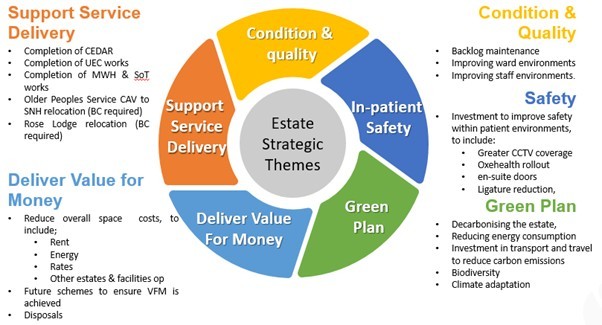
Figure 16 Estate Strategic Themes
Completion of Major Developments Currently Underway
A number of work programs and estates initiatives which form part of the key Estates changes for the next 2 years have in part been developed prior to the writing of this strategy document, specifically.
The work associated within the following areas has been brought together under one program known as CEDAR
- New Care Models for Adult Secure Services
- NHS England National Adolescent MSU review
- Newcastle & Gateshead Delivering Together
This scheme will result in adult secure services located on a single site at Northgate Hospital and young people’s secure services relocated onto Ferndene. The new facility at Northgate will be occupied in the spring of 2023 (see figure 17 below). These moves will enable site rationalisation, improved service productivity, a greater critical mass of clinical expertise and expansion to enable repatriation in line with national strategy and the Mental Health 5 Year Forward View.
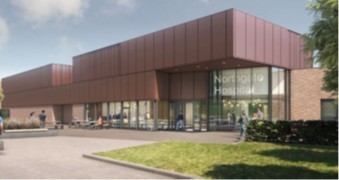
Figure 17 Artist’s impression of the new MSU at Northgate
Following the transfer of secure beds from Bamburgh Clinic, the building will be extended and upgraded to allow for the adult acute admission facilities from the CAV site to move into the vacated space in Bamburgh Clinic. This will result in all acute adult in-patient beds being located on the one site. The expected move from the CAV site to Bamburgh Clinic is the summer of 2024.
The development will also free up space on the St Nicholas Hospital site, specifically Alnwood and Lennox wards, which could be utilised as an option for the relocation of the Older Peoples in-patient services from the CAV site.
The Ferndene element of the CEDAR project has been subject to a recent review (Nov 2022) and approval has been given modify the clinical service delivery as identified in the original CEDAR Business Case. The original model known as the “Integrated Model” would see the wards reduce from 4 to 2, delivering; 14 GAU beds (10 MH and 4 LD), 4 PICU beds and 6 LSU beds (3MH, 3LD). When implementing the integrated model, it quickly became apparent that there is added clinical complexity and safeguarding challenges when managing this complex and vulnerable client group from different pathways in the same environment. The review recommended a different approach with the preferred option to create 5 discrete clinical areas that take into account diagnostic criteria, clinical presentations, and security levels, these being: MSU – 7 MH beds (a reduction of 7), GAU – 10 MH beds, PICU – 4 beds, LSU – 3 MH beds and Specialist LD & Autism – 7 beds. This work has been incorporated into a Phase 3 package of work which will deliver against this revised business case, and it is expected the work will be complete in the spring / summer 2024.
The CEDAR development will deliver against each of the five strategic themes and at the Northgate site will remove a range of buildings that have high levels of backlog maintenance are of a poor quality and poor functional suitability.
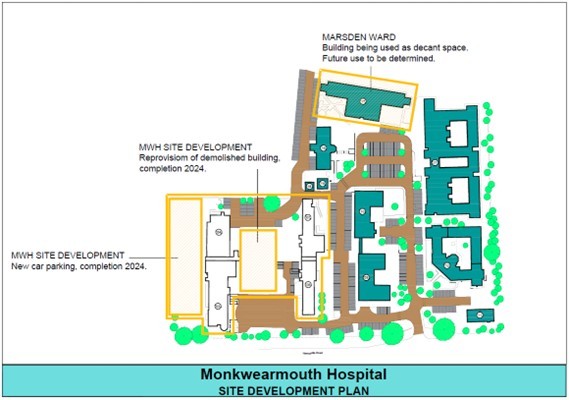
Demolition of some of the older parts of Monkwearmouth Hospital has occurred (Dec 2022) and redevelopment of the site is underway and will be complete early 2024. The development will also see the vacant site at Boldon Lane Clinic, demolished and either disposed of or rebuilt as a new base for the CYPS service which is currently utilising high cost rented accommodation at Cleadon Park.
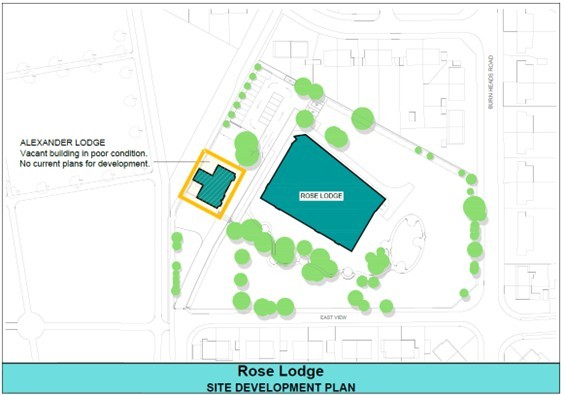
The South Tyneside Older Peoples Service that was previously located out of area at Monkwearmouth Hospital will either return to MWH or be relocated into alternative rented accommodation or a refurbished Alexandra Lodge which is adjacent to Rose Lodge.
An artist’s impression of the redeveloped Monkwearmouth Hospital is shown in figure 18 below.
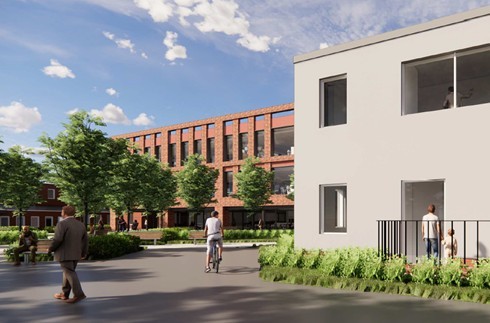
Figure 18 Artist’s impression of the redeveloped Monkwearmouth Hospital
The Monkwearmouth and South of Tyne Developments will deliver against each of the five strategic themes and will remove a range of buildings that have high levels of backlog maintenance are of a poor quality, poor functional suitability and had associated safety issues related to structural deficiencies and asbestos contamination.
Benton House in Newcastle is a leased community property which has been utilised by the Trust for almost 20 years. In 2022 the Trust agreed with the new Landlord to extend the lease and occupy the whole of the building. The building has been refurbished in order to accommodate other teams, and this work will be complete in early 2023 (see figure 19 below).
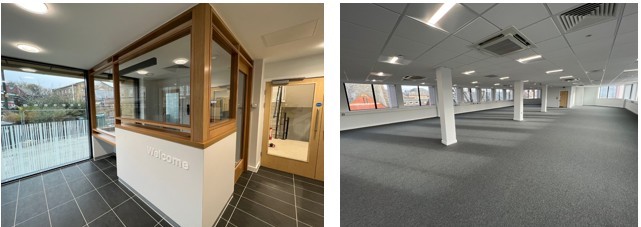
Figure 19 Refurbished space at Benton House
The additional space will provide an opportunity for services to relocate to Benton House. Work is currently underway with the CBU’s to identify and finalise those teams where relocation will deliver benefits, and it is anticipated this will result in the building being fully occupied by the summer of 2023. The teams currently being considered for relocation include the community service based in the Molineux centre who are in high cost rented accommodation, the CYP CEDS North of Tyne (formerly EDICT) service who are looking to consolidate into a single location and the creation of a CYPS crisis team assessment centre which forms part of the UEC bid.
The Benton House scheme will deliver against a number of the strategic themes, in particular improvements to the quality and suitability of the estate following refurbishment, the delivery of cost savings associated with relocation from the Molineux Centre and is supporting service delivery through the relocation of teams.
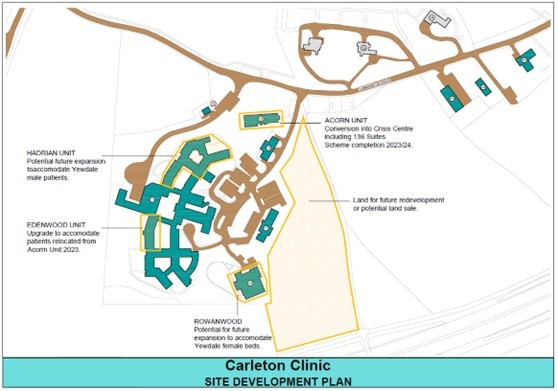
The Hadrian Unit was a 22-bed mixed sex adult acute in-patient ward. The unit had a significant number of environmental and safety shortfalls, and these are being addressed as part of a comprehensive upgrade. The original plan was to reduce the beds to 20 and provide bedrooms with en-suite facilities along with other environmental and safety improvements and return the ward back to a mixed sex unit. During the upgrade the service moved the male patients into the former PICU unit and the CBU have decided they will operate this split service moving forward. The upgrade has been modified and now a number of bedrooms will not be upgraded and will instead be mothballed.
There is an opportunity to look at the bed model on the Carleton Clinic site to see if it can be used as a single site for North Cumbria bed-based services and facilitate the relocation of the Yewdale beds.
The Hadrian Unit upgrade will deliver against a number of the strategic themes, in particular improvements to the safety, quality and suitability of the estate following refurbishment and supporting service delivery.
It was identified nationally that there are MH priorities in the UEC pathway. Funding was made available for schemes that would relieve pressure on the pathway, by either:
- Diverting people away for Emergency Departments.
- Improving experience in Emergency Departments.
- Allowing for timely transfer to an appropriate MH service.
Examples of:
- Safe spaces and sanctuaries (including Health Based Places of Safety)
- Dignified spaces in or near EDs, this may include adapting existing spaces or bays
- Dedicated mental health response vehicles to add capacity to ambulance services and divert people from ED.
- Crisis beds or intermediate step up/down services to support flow
- Specific types of MH inpatient beds to address gaps in certain areas
The Trust was successful in a number of bids to be delivered in 22/23 and 23/24, these are summarised as follows:
Cumbria
- This scheme seeks to expand the capacity of the current S136 facility to two and improve the standard of the suite in terms of patient safety and experience. It will reduce the frequency of the inappropriate holding of patients in police facilities and emergency departments. It will also enhance the layout and facilities within the suite to support de-escalation, improve safety for patients and staff and promote earlier recovery.
- The works will be carried out on the Acorn Ward and will require some enabling works to be undertaken to relocate the LD patients back into Edenwood.
- The value of the scheme is £3.1M
Newcastle and Gateshead
- Upgrade the 136 Suite located at St Nicholas Hospital.
- The value of the scheme is £65k.
- Create a CYPS Crisis Team assessments on the ground floor of Benton House with a separate entrance into the building to allow for separation of children and adults as they enter the building.
- The value of the scheme is £150k.
Northumberland
- Upgrade the 136 Suite located at St Nicholas Hospital.
- The value of the scheme is £30k.
System Wide – Non CNTW
- In addition to the bids submitted by CNTW, a number of partner organisations have submitted bids and are carrying out works to provide a range of facilities to support patients. These schemes include the provision of crisis cafes, crisis housing, safe spaces, and autism cafes.
- The UEC works will deliver against a number of the strategic themes, in particular improvements to the quality and suitability of the estate following refurbishment, and in supporting service delivery and delivering value for money by ensuring patients in crisis are seen in the most appropriate setting.
Completion of Other Minor Schemes in 22/23 & 23/24
At the time of writing this strategy a number of other smaller schemes are underway in both this and the next financial year, these are identified in the capital program and are shown in table 21 and 22 below. Collectively these schemes will contribute to the five strategic themes.
| Major Schemes |
22/23 |
23/24 |
|---|---|---|
| CEDAR |
24,868 |
3,255 |
| Additional CEDAR Schemes |
2,260 |
|
| Approved CEDAR Increase |
2,614 |
|
| Hadrian Unit Carleton Clinic |
3,609 |
|
| Monkwearmouth / Boldon Lane Clinic |
800 |
2,200 |
| Ferndene - Phase 3 |
1,000 |
3,300 |
| Total |
£35,151 |
£8755 |
Table 21
|
Other Developments |
22/23 £000 |
23/24 £000 |
|---|---|---|
| Eating Disorders Service, Newcastle |
|
250 |
| Park Lane, Cumbria - Phase 2 |
210 |
|
| Tweed Courtyards |
|
222 |
| Metal Detectors |
100 |
|
| Oxehealth Implementation |
259 |
541 |
| En-suite doors Implementation |
100 |
100 |
| Yewdale Improvements & Roof Repairs |
197 |
|
| Newton Enhanced Care Area |
8 |
|
| Blue Bell Court Ph2, SGP |
24 |
|
| Blue Bell Court/Kinnersley, SGP CCTV |
6 |
|
| Elm House – Staff Room |
4 |
|
| SGP – Anti-Barricade Doors |
9 |
|
| Woodhorn, SGP – Low Stimulus Soft Room |
10 |
|
| SNH - Absence line moves |
80 |
|
| Hopewood Pipe Replacement |
150 |
|
| Storage/Food bank |
150 |
|
| Nurse Call |
100 |
100 |
| Total |
£1,407 |
£1,213 |
Table 22
Targeted Investment to deliver against Strategic Themes
There is an allocated capital investment program for the next 5 years which delivers against the strategic themes, this is shown in table 23 below and described in the following sections.
| Scheme | Annual allocation £000 |
|---|---|
| CCTV |
300 |
| Equipment |
100 |
| Backlog/Carbon Reduction/Sustainability |
2,000 |
| Safety/Clin Environment Safety |
500 |
| Minor under £25k schemes |
200 |
| Refurbishment patient areas |
500 |
| Refurbishment Non-Inpatient Areas |
500 |
| Internal Fees |
400 |
| Total |
4,100 |
Table 23 Annual Capital Allocation- 5 Year Forward plan
In Section 4 of this strategy, reference is made to the Trusts Green Plan which was developed following the Trusts declaration of a Climate Emergency. The Green Plan sets out a number of Estates related actions that CNTW will need to achieve, which includes decarbonisation, improving biodiversity and ensuring we make adaptations to buildings to allow for climate change.
A high-level decarbonisation assessment of the Trust estate was carried out by an external consultancy in 2022, the data from this study coupled with other site intelligence identifies that the costs of decarbonising the estate will be up to £30M.
Full decarbonisation is unlikely to be achievable with current technologies, therefore the strategy should be to invest in schemes which reduce both energy consumption and carbon emissions and also to increase the proportion of energy consumption generated from renewables.
Investment is not limited to decarbonisation but also in improving the biodiversity of our sites and adapting buildings and sites to cope with climate change.
What needs to be done and when?
- A detailed decarbonisation plan needs to be developed on a site-by-site basis to determine what is feasible in respect of reducing carbon emissions. Plans should take into account the construction elements of the buildings, configuration of engineering services, building use and if there are any opportunities to partner with other organisations who we can partner with on area wide initiatives. This should be completed by the end of 2023 and will need to be reviewed on an on-going basis.
- Invest in the short-, medium- and long-term decarbonisation schemes addressing those areas where elements of the Green Plan can be delivered, in particular reducing our own carbon emissions towards net zero by 2040. Focus will be given to:
- A move away from steam heating systems on the St Nicholas Hospital site.
- Maximise potential for solar PV generation.
- Improvements to building and engineering services insulation levels.
- Optimising control of energy using equipment including heating systems.
- Full implementation of LED lighting with associated smart controls.
- Ongoing awareness campaigns for staff in energy efficiency.
- Maximise suitable use of renewable heating technology such as air source heat pumps.
- Enhance the Electric Vehicle charging infrastructure to facilitate staff changing to EV’s and their adoption for Trust vehicles.
- Making the most of our green spaces for service users, carers, staff and local communities to enjoy, encouraging biodiversity and connection with nature. This will require a detailed biodiversity plan to be developed on a site-by-site basis. This should be completed by the end of 2023 and will need to be reviewed on an on-going basis.
- Invest in the short-, medium- and long-term biodiversity schemes addressing those areas where elements of the Green Plan can be delivered where biodiversity can be implemented. Focus will be given to:
- Transforming areas of outdoor space into across the main sites into wildflower meadows.
- Develop wellbeing gardens across
- Create outdoor walking routes across the main sites
- Explore opportunities to utilise the large field at SNH in a way that promotes biodiversity
- Climate change is posing a risk from weather changes that may impact on the Trusts ability to deliver services, in particular risks from flooding and extreme weather. A detailed site and building adaptation plan need to be developed to determine what is required to ensure our estate is suitable for use in future years as a result of climate change. This should be completed by the end of 2023 and will need to be reviewed on an on-going basis.
- Invest in the short-, medium- and long-term adaptation schemes addressing those areas where the risk and need is greatest. Focus will be given to:
- Reducing flood risk
- Mitigating against high temperatures in clinical areas without resorting to installing cooling, unless absolutely necessary.
The above areas for action is not an exhaustive list and it is acknowledged that there is a lot of work to do in terms of developing a detailed decarbonisation plan.
A capital allocation of £1500k per annum from 23/24 onwards has been identified in the capital program. The management of this budget and the prioritisation of schemes will be done via the sustainability, waste and transport committee (SWAT) with oversight on expenditure managed through the Capital Group meeting. Progress on carbon reduction and general delivery against the Green Plan will be monitored via Trust Leadership Team and also reported to RBAC.
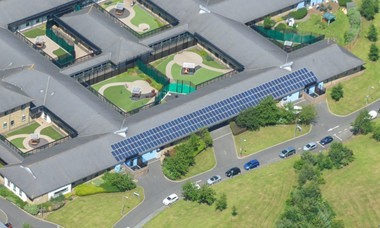
In Section 4 of this strategy, reference is made to the Trusts Strategy and other drivers that emphasise the need to ensure the condition and quality of the Estate is maintained at acceptable levels. This is reinforced by the CQC Fundamental Standards which state that “the places where you receive care and treatment, and the equipment used in it must be clean, suitable and looked after properly”.
Over the last 17 years the Trust has invested substantially in improving the estate and eradicating areas of poor condition and quality, however as the Estate ages it is necessary to maintain investment to ensure standards are maintained. Section 3 of this strategy identifies through elements of the six-facet survey and the PLACE inspections that there are pockets of estate where standards could be improved.
The backlog maintenance position is intrinsically linked to poor quality estate. The Trust has managed its backlog position over the last 17 years primarily through asset replacement supported by a targeted investment program. This Strategy has been usefully employed by the Trust for a number of years for example the replacement of St Georges, Hunters Moor, Prudhoe and Cherry Knowle Hospitals and more recently with the development at Northgate Hospital.
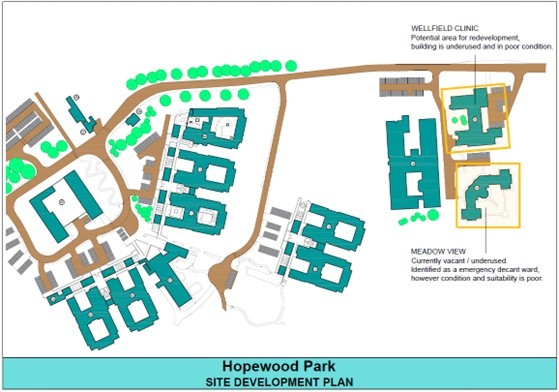
Currently the main pockets of backlog maintenance have been at Northgate and Monkwearmouth Hospitals, and this has been addressed through the current investment program. There are a small number of assets that account for the majority of the backlog position, and these include site steam infrastructure at SNH, Collingwood Court at SNH, Meadow View and Wellfield Clinic at Hopewood Park, Carleton Clinic and Portland Square in Carlisle.
Without investment the backlog maintenance position will continue to grow year on year, increasing operational risks and leading to a decrease in the quality of the estate. In order to address the backlog maintenance position a targeted approach of investment is required over the next 5 years and an allowance of £0.5m/annum has been made in the capital program. In future years, as assets begin to age, the requirement to invest in asset replacement will grow and appropriate capital allocation will be required to prevent the backlog position growing.
In order to maximise value from the capital available, the Estates Department will submit annual plans for approval by the Trust for specific investment in backlog maintenance schemes.
What needs to be done and when?
- Continued investment across the whole Estate to ensure those areas that are currently rated in condition C/D are managed to ensure their condition is maintained to those standards and does not deteriorate – this is a continuous process.
- Invest in the short-, medium- and long-term schemes addressing those areas where improvements can be made within the capital allocation.
- Target investment in backlog maintenance reduction.
A capital allocation of £1.2M per annum from 23/24 onwards has been identified in the capital program for minor schemes under £25k, refurbishment of patient and non-inpatient areas. The management of this budget will be via the Capital Management Group. A further £0.5M per annum from 23/24 onwards has been identified in the capital program for backlog maintenance. The management of this budget will be via NTWS and reported into the Capital Management Group.
In section 4 of this strategy document the case for prioritising patient safety is made clear. The Trust needs to provide facilities that are safe and minimise the opportunity for harm to be caused and Facilities need to comply with legislation and CQC requirements. There are currently a number of schemes that are in progress listed in the section below.
What needs to be done and when?
- Continued investment across the whole Estate to ensure those areas that are currently rated as safe are maintained to those standards, this is a continuous process
- Invest in the short-, medium- and long-term schemes, addressing those areas where safety can be enhanced, a number of schemes are underway and other safety improvements have been identified, in particular:
- Replace en-suite doors within inpatient wards that are deemed to present a ligature risk to that patient group. This will require circa 500 en-suite doors to be replaced. This work is included in the current capital program and will be completed in the 23/24 FY.
- Extend the roll out of nurse call systems to those wards where it is deemed necessary affecting around 500 beds. This work is in part included in the current capital program.
- Extend the roll out of CCTV on wards and grounds. This will cost circa £1.6M plus an on-going revenue. There is an on-going capital allocation to address CCTV needs.
- Standardise the seclusion rooms to increase the robustness of the building fabric. This will affect 37 seclusion rooms at a cost of circa £1.8M.
- Roll out Oxehealth. For 600 bedrooms this will cost circa £850k plus an on-going revenue. This work is included in the current capital program and will be completed in the 23/24 FY.
- Metal detection to all wards and S136 Suites. This will cost circa £700k. This work is included in the current capital program and will be completed in the 23/24 FY.
- Standardise wash hand basins in en-suite areas to remove a potential ligature issue associated with the drain size – cost circa £500k.
- Safe window design – to install circa 300 windows to create a safer solution – cost circa £1M
- Standardise staff attack systems to one system in order to improve operational reliability and safety, cost circa £300k.
- Review access control systems with the aim of improving operational reliability, increasing access and reducing impact of lost keys.
The above list is not exhaustive, it is also the case that safety improvements can be identified following inspections, learning from incidents and the availability of new technology.
A capital allocation of £800k per annum from 23/24 onwards has been identified in the capital program. The management of this budget and the prioritisation of schemes will be done via the Clinical Environmental Safety Group with the work undertaken by NTWS.
Supporting Service Delivery (Funded and Unfunded Schemes)
In section 4 of this strategy the case for supporting service delivery is clear. The Trust needs to provide facilities that functionally suitable and in the right location in order to provide an efficient and high-quality service. There are currently a number of schemes that are in progress which will improve service delivery.
There are also a number of schemes which have been identified by the Trust as being a priority, but where no funding is in place. These schemes include the relocation of the OPS service from the CAV site and the relocation of Rose Lodge onto a main hospital site, the options for both these schemes are detailed as follows:
The CNTW Older Adult In-Patient, Community & Day Services in Newcastle, are currently located at the Centre of Aging Vitality (CAV) which is owned by Newcastle University and leased to CNTW.
The current lease expires at the end of March 2023; however, assurances have been sought from the University that these service can remain on site until Autumn 2024.
There have been on-going discussions across the Newcastle system, around the long-term vision for the Older Adult services in Newcastle. One option being the development of an Integrated Well-being Hub on the CAV site, which would include services from CNTW, Newcastle Hospitals, Local Authority and independent Sector. The vision of what this Integrated Hub would look like and how it would function has evolved over time and somewhat digressed from the initial scope and plans. Rising capital requirements and access to capital funding for the overall Integrated Hub project has proved challenging, this and other factors have resulted in a delay on the project, and it is now unlikely that the original planned timescales of this project, will be delivered by 2026.
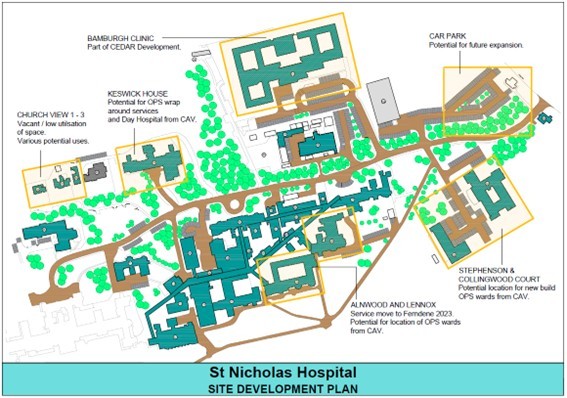
CNTW have therefore scoped out alternative options to bring the Older Adult Services onto the St Nicholas Hospital site and ensure in-patient and community services remain co-located. This supports a 1 site model for Central Locality in-patient services, similar to that in other localities. There are two options in the draft business case:
- The short to medium term proposal is to The Ashby, Lennox and Wilton wards are currently occupied by Children’s Services, and these services are due to relocate to Ferndene in May 2024. Work would commence immediately upon vacation, and it is envisaged that this work would take 12 months to complete, which would be complete by May 2025.
- This option would result in the in-patient services remaining on the CAV site for potentially a further 8 months, after the lease extension expires in Autumn 2024. This would therefore need to be renegotiated with the University.
- The capital cost of this option is circa £5.5M.
- The long-term proposal, which is the preferred option should funding be available, is for a purpose new build development on the SNH site, where Collingwood Court and Stephenson Court are located. This would be for in-patient services and Community Team staff base, and Day Services would move into Keswick under this option. However, the funding required for this financial and time restrictions around this proposal.
- This option would result in the in-patient services remaining on the CAV site for at least 12 months, after the lease extension expires in autumn of 2024. This would therefore need to be renegotiated with the University.
- The capital cost of this option is circa £20M.
Rose Lodge is a learning disability specialist assessment and treatment inpatient unit based in Hebburn, South Tyneside. Rose Lodge has 10 beds providing acute assessment and treatment by a multi-disciplinary team.
The service has voiced concerns over the isolation of the service and that they would benefit from being located on a main site.
A business case would be required to develop the options, including what happens to the Rose Lodge site. A new unit on a hospital site would cost around £8M and there is no available capital funding in the current capital program.
The Yewdale ward is a 16-bed mixed sex standalone unit in the West of North Cumbria based at Whitehaven in the West Cumberland Hospital. Should the CBU wish to consolidate services onto a single site this can be achieved at Carleton Clinic.
The existing accommodation would need investment to create a circa 17 bed male ward on Hadrian by continuing with the bedroom upgrades and by extending Rowanwood by circa 5 beds a 15-bed female ward can be created. This work would cost around £3M and there is no available capital funding in the current capital program.
Land sales and asset disposals
At its formation in 2006 the Trust had significantly more land than it required to undertake its clinical functions. This allowed for the rationalisation of the estate which led to significant capital receipts from disposals which has then been reinvested in the estate - notably on the autism project at Northgate. In addition to the surplus land, the Trust has also disposed of buildings which were no longer strategically required for the delivery of clinical services or for staff accommodation.
This strategy of land and space rationalisation will continue, and known plans are detailed below.
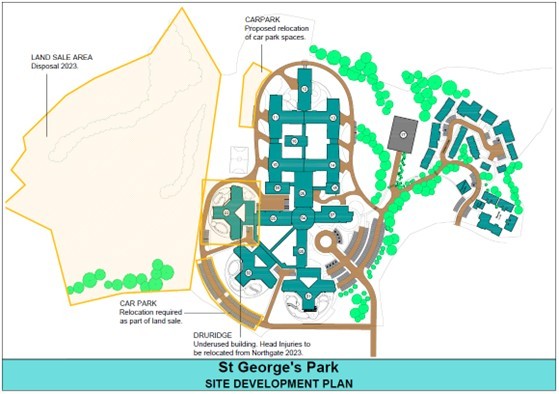
The Trust owns a parcel of land to the North of the existing St Georges Park Hospital. This land is surplus to the needs of the Trust and is located on the former hospital site that is currently undergoing extensive development for residential housing. The intention is to sell this for residential development.
It is intended this sale will be completed in 2023 and is estimated to generate a capital receipt of £3M.
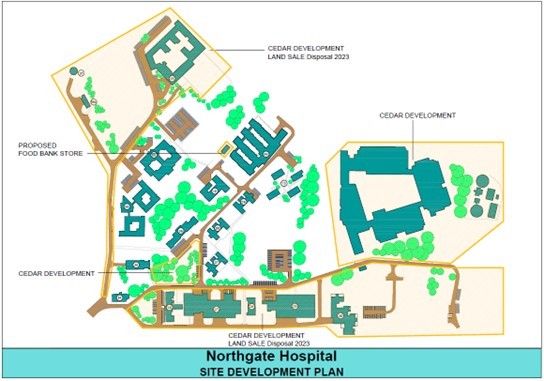
The Trust disposed of a large part of the Northgate Estate in 2014 for residential housing development. Further retraction from the site has resulted in the opportunity to dispose of more land and this will be done as part of the wider site redevelopment under the CEDAR program of works. It is intended this sale will be completed in 2023 and is estimated to generate a capital receipt of £7.8M.
The Trust has a number of smaller properties which depending on a range of circumstances have the potential to be sold or developed for on-going Trust use, these include:
Other Potential Asset Sales
Boldon Lane Rose Lodge (subject to service relocation)
Hillview Clinic Alexandra Lodge (packaged with Rose Lodge)
The Grange Lobley Hill Clinic
Each disposal will be the subject of an individual business case which will ensure that best value is achieved, values will be determined at the time of the sale.
Site Development Plans
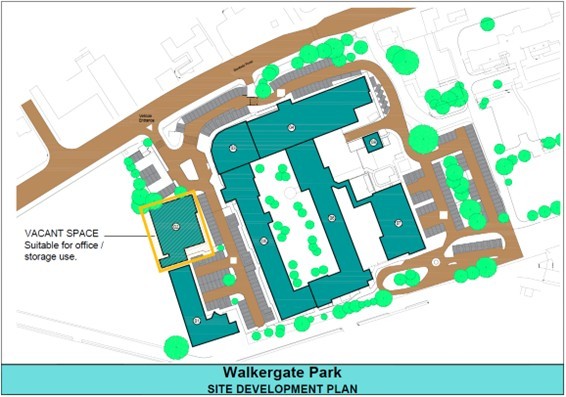
A number of the sites across the Trust have some form of development requirement which has been and these cover a wide range of issues and In order to understand these requirements, site development plans have been developed to illustrate the opportunities and challenges on a site by site basis (see figures 20 - 28 below).

In order to deliver an ambitious capital program of work over the next 5 years, coupled with the planning required and the associated land sales, the Trust will require a number of elements to be in place, including:
- Expertise and team working.
- Procurement framework.
- Construction partner.
- Capital funds.
The Trust has within its operating group the expertise within the Estates Department to deliver the specialist aspects associated with overseeing the construction contract. The Estates Department works with a wider team for the scheme development and delivery, including:
- Clinical staff.
- Patients and carers.
- Specific multi-disciplinary project boards and planning groups.
- Architects.
- Specialist designers and consultants.
The Estates Department has been involved in the delivery of a continuous stream of capital projects over the last 18 years, building up experience and expertise that will be invaluable in the delivery of the Estates Strategy over the next 5 years.
The Trust is required to procure contracts over a certain value in a way that meets OJEU law. In order to achieve this, CNTW appointed PAGABO as their contract management agent for the National, OJEU-compliant framework for Major Construction Works (ref AVP-NTW-1002). It is intended to utilise this procurement framework for the delivery of the capital schemes with our construction partner Sir Robert McAlpine.
The Trust recognises the benefits of partnering with a contractor to develop a long-term program of works as opposed to changing contractors on each scheme. Following a rigorous selection process Sir Robert McAlpine (SRM) were selected from the PAGABO framework. SRM have now successfully delivered a number of projects for NTW and are currently developing the CEDAR program.
The Trust’s operational plan included a capital programme totalling £82.2M over the next 6 financial years with planned spend of £17.1M in 2023/24. A revised plan is being developed at the time of writing this strategy to take into account slippage in the 22/23 FY and proposed changes to the CEDAR scheme.
The availability of capital funds in future years is constrained primarily by the Trusts lack of available cash, coupled with the need to operate within a CDEL that has been allocated to the ICS in which we operate. The demands on the capital across the ICS outstrip the allocated CDEL and hence the ability to simply spend on unplanned schemes or those not agreed within the ICS is not possible, unless some form of non CDEL allowance is forthcoming.
Summary
When formed in 2006, the new organisation inherited a large diverse property portfolio much of which was in a poor condition and had low levels of quality and functional suitability. That position has largely been reversed over the last 17 years as a result of sustained and targeted capital investment. The Trust is rightly proud of the significant advances in improving the quality of the patient environment it has made since its formation with many award-winning innovative capital developments which have been recognised for the contribution they make toward clinical care.
However, there still remains a range of accommodation which does not enhance the patient experience, and these are in need of improvement or replacement.
This section has detailed the works required to build on the previous Estates strategies, setting out the general scope of the work required over the next 5 years and how this will be delivered and what the expected outcomes will be. The key elements to ensure successful delivery are in place, including aligning the Estates Strategy to the clinical Strategy, delivery teams for bigger schemes have been established, a procurement strategy is in place, a construction partner identified and lastly a capital program has been established to provide funding.
The Trust remains committed to a program of continuous development and improvement in the services it provides and this needs to be reflected in the environments provided for both patients and staff. By ensuring the Estate Strategy is aligned with the Service Development Strategies, the Trust can be confident that its investment programme will deliver further improvements to ensure environments that are fit for purpose which will support the Trust in realising its vision.
The Estate Strategy has taken into account the Trust’s vision, core values and strategic objectives, in addition to the service-specific requirements as set out in the Trusts Strategy and to have ‘facilities fit for purpose’ that complement the service needs of the organisation.
The Estate Strategy provides a framework from which we will be able to monitor and measure our progress in ensuring that the Trust Estate performance meets the expectations of the organisation in line with the investment being made over the next 5 years. It will be imperative that the Trust ensures that future investment is in keeping with the Trust’s strategic objectives and goals, core service requirements, models of care and the capital funding envelope. The Strategy is a dynamic document outlining a programme of work that will be reviewed regularly as service priorities change and development opportunities arise.