
CNTW Estates Strategy - Introduction to the Estates Strategy
Executive Summary
Introduction
This document sets out the Cumbria, Northumberland, Tyne and Wear NHS Foundation Trust (Trust) Estates Strategy for the period 2023 – 2028.
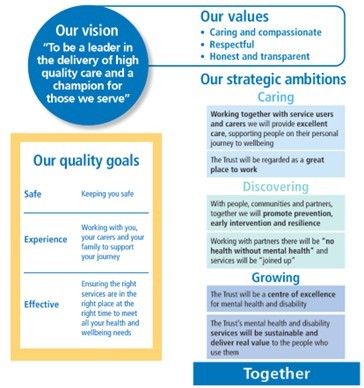
The aim of this Estate Strategy is to provide a user-friendly working document that clearly identifies the changes required to the Estate to enable the services provided by the Trust to be delivered in accordance with their strategic objectives. It sets out the long-term plan for developing and managing the Estate in an optimum way in order to meet the Trusts vision of being a “leader in the delivery of high-quality care and a champion for those we serve” and its underpinning values, strategic ambitions and quality goals. The strategy is aligned to both National and Local Strategies and those of the Integrated Care System (ICS).
This strategy will address three strategic questions; where are we now? where do we want to be? and how do we get there? In answering these questions, the strategy will also take into account the following:
- The Trust’s existing estate, including an analysis of its overall condition and suitability and a reflection of the developments that have been carried out over the last few years providing a context of where we have come from and an understanding of where we want to be.
- How the service development strategies of the clinical and support services teams along with relevant external factors influence the way in which the estate is provided and needs to be developed.
- The proposed changes to the Estate, providing an environment suitable for the delivery of the Trusts services over the next 5 years and beyond, supported by an investment programme which includes rebuilding, upgrading and delivery of the changes required.
- The significant challenges faced by the organisation in respect of access to capital funds and the restrictions imposed on CNTW as they operate to the capital departmental expenditure limit (CDEL) in place across the ICS.
Where are we now?
Overview
Cumbria, Northumberland, Tyne and Wear NHS Foundation Trust (CNTW) was formed on the 1st October 2019 following the transfer of mental health and learning disability services from Cumbria Partnership NHS Foundation Trust to Northumberland, Tyne and Wear NHS Foundation Trust. Northumberland, Tyne and Wear NHS Trust (NTW) was established on 1st of April 2006 following the merger of three Trusts: Newcastle, North Tyneside and Northumberland Mental Health NHS Trust, South of Tyne and Wearside Mental Health NHS Trust and Northgate and Prudhoe NHS Trust. The Trust achieved authorisation as an NHS Foundation Trust on 1 December 2009.
Since its inception in 2006 the Trust has undergone significant changes both in the makeup of its Estate and the expansion of its geographical area to provide care in North Cumbria and a CAMHS service in Middlesbrough. The Trust now operates from over 75 sites across serving a population of approximately 1.7 million and providing services across an area totalling 4,800 square miles.
The Trust provides a range of mental health, learning disability and specialist services across the north east and north Cumbria, with wards and day services; a number of community teams, including drug and alcohol, psychosis, autism and ADHD, homelessness and street triage with Northumbria Police.
The clinical services provided by the Trust are organised into 4 Clinical Business Units (CBU’s) covering each of the geographical locations, with each CBU incorporating access, community, in-patient and specialist services teams.
The majority of corporate services are based at St Nicholas Hospital, including finance, workforce, informatics, and the executive team. It is also a base for the Trusts subsidiary company - NTW Solutions.
The CQC, the independent regulator of health and social care, have rated the Trust as “Outstanding” in their last inspection report published in August 2022. Inspections have identified some areas where environmental or estates related safety improvements are required and these have either been addressed or plans are in progress.
PLACE is an assessment programme run by NHS Digital on behalf of NHS England and NHS Improvement (NHSE/I) which is completed on an annual basis.
The PLACE assessments indicate that within patient areas the main focus for potential improvements were in areas of privacy & dignity, dementia and disability.
Previous estate strategies have focused on a range of key priorities which are summarised as:
- Reprovision of facilities to replace poor quality accommodation.
- Reduction in the backlog maintenance position.
- Optimisation of the estate; right size, place, cost effective and meeting user needs.
- Ensuring the patient environment is at an acceptable level.
Since the last Estates Strategy and the period thereafter, the above priorities were addressed through a number of significant projects and initiatives which have been delivered, including:
- Ferndene children’s inpatient accommodation.
- Hopewood Park.
- Roker, Mowbray and Cleadon on the Monkwearmouth site.
- Tyne - Long Term Low Secure re-provision (Villa 19 Replacement, Northgate Site).
- Alnwood improvements at St Nicholas Hospital.
- Mitford - autism unit replacing Villa’s 11 and 16 at Northgate.
- Community transformation project.
- Edenwood modular building at Carleton Clinic.
- Development of a Medical Education Facility on the St Nicholas Hospital site.
- Disposal of surplus land and assets.
In addition to the above there are a number of significant capital schemes which are currently underway, including.
- The CEDAR programme; established to undertake the service planning and implementation of three major capital developments:
- The development of an integrated adult mental health and learning disability secure services centre of excellence at Northgate Hospital.
- The re-provision of Newcastle and Gateshead adult inpatient services onto the St Nicholas Hospital.
- The re-provision of Children and Young People’s (CYPS) medium secure inpatients services into Ferndene.
- Backlog maintenance schemes in 22/23 totalling £0.5M
- Energy Efficiency schemes in 22/23 totalling £0.5M
- Hadrian Unit at Carleton Clinic major upgrade (underway)
- Upgrades to Yewdale Ward at Whitehaven Hospital (underway)
- Monkwearmouth Hospital major redevelopment (underway)
- Relocation of Older Peoples service from the CAV site (Planning)
- Inpatient safety schemes including the roll out of En-suite door replacement and installation of Oxehealth patient monitoring systems.
- Urgent and Emergency Care (UEC) developments across the Trust to be delivered in 22/23 & 23/24.
Estate Portfolio
The Trust has an extensive estates portfolio comprising some 280 buildings spread across 75 sites with ages ranging from the 1870’s to the present day and with a number of different types of tenure. These consist of 9 principal sites with the remainder being made up of satellite properties across a large geographical area, the principal sites are:
- Northgate Hospital, Morpeth
- St George’s Park, Morpeth (PFI)
- St Nicholas Hospital, Gosforth, Newcastle upon Tyne
- Walkergate Park, Newcastle (PFI)
- Ferndene, Prudhoe
- Campus for Ageing and Vitality (Leased)
- Hopewood Park, Sunderland
- Monkwearmouth Hospital, Sunderland
- Carleton Clinic, Carlisle
The accommodation is provided via a mix of tenures including owned, leased, informal tenancies, licence, PFI and service level agreements, the approximate tenure split of the overall gross internal area is as follows:
- 66% is owned
- 17% is operated under a PFI agreement
- 12% is formally leased
- 6% is by way of informal tenancies, licence, SLA
Services are also provided from a wide range of settings, including A&E Departments, wards based on acute hospital sites, community premises, health centres, GP Surgeries and clinics, Police Stations and patient homes. The Trusts full property schedule and location plans are contained in Appendix 1.
Surplus land at Northgate Hospital and St Georges Park is currently in progress with expected completion in 2023. These two land sales represent the major asset disposals at this time, there are other assets that have been identified in this strategy that may be considered in the future for disposal.
Estate Metrics
The following sub-sections provide an overview as to the make-up, condition and other metrics related to the Estate:
The age profile of the estate has changed following a programme of replacing outdated and unsuitable accommodation with modern purpose-built facilities. The Trust now has 38% of its Estate constructed after 2005, this is an increase from 28% in 2012 and this position will improve further when current projects are delivered.
The bed numbers in the Trust and the associated occupied bed days had seen a steady year on year drop which was reflective of changes to the services provided by the Trust and operational efficiencies that have been made. The inclusion of the North Cumbria and Acklam Road beds in 2019 and 2021 respectively have had the impact of reversing the bed reduction trend and bed numbers in the enlarged Trust are now comparable with NTW in 2018. The planned bed number prediction for the end of the 22/23 FY is as follows:
- 791 commissioned beds.
The net book value of the estate is £221 M and this attracts capital charges of £11 M / annum.
The six-facet survey is a long-established set of metrics used in the NHS. The six facets take into account physical condition, safety, functional suitability, quality, space utilisation and the environment. So, between them we can build up a picture of the estate which can be scored at a point in time and then compared against previous scores to determine the trend but can also be used to create a target for improvement.
The facets are generally rated on a simple scale of A-D (Excellent – Poor) with space utilisation being graded according to occupancy.
The current performance of the overall Trust Estate against each of these facets is detailed in table 1 below, note that this takes into account the completion of the Northgate adult MSU:
| Facet | Ranking % | Ranking % | Ranking % | Ranking % |
|---|---|---|---|---|
|
A |
B |
C |
D |
|
|
Physical condition |
7.5 |
81.5 |
10.7 |
0.3 |
|
Quality |
5.6 |
82.3 |
12.1 |
0 |
|
Functional suitability |
24.5 |
70.5 |
5 |
0 |
|
Fire, health and safety |
21.9 |
73.2 |
4.9 |
0 |
|
Environmental management |
0 |
60.5 |
36.6 |
2.7 |
|
|
Full |
Underused |
Overcrowded |
Empty |
|
Space Utilisation |
85.8 |
9.4 |
0.8 |
4.1 |
Table 1 Overall Six Facet Survey Summary
The Trust’s backlog maintenance is intrinsically linked to overall condition of the Estate. As of Q4 22/23 the backlog maintenance figure is approximately £5M. This figure represents the expenditure needed to bring the existing Estate up to a minimum of condition B standard, however, this sum would not address the problems of poor functional suitability, safety issues and quality.
The trend over the last 4 years has been increasing and this was due to a deteriorating position at Northgate Hospital, Monkwearmouth Hospital and the addition of the Carleton Clinic and other North Cumbria Estate. Whilst the current capital program is addressing Northgate and Monkwearmouth Hospitals there remains pockets of backlog maintenance issues across the estate.
Where do we want to be?
This section considers the potential estates implications associated with key drivers for change and service development strategies of the organisation.
Internal Drivers
The Trust is in the process of updating its strategy. The current strategy has set out a framework for its Vision, Values, Quality Goals, Strategic Ambitions and Plans and this is illustrated below in figure 1.
The estate plays a significant role in the delivery and support of the Vision, Values, Quality Goals, Strategic Ambitions and Plans and underpins day to day work activities and the care of the patients and needs to deliver in a number of areas including:
- Therapeutic, homely, peaceful
- Safe, but not overly restrictive
- Be located in the right place
- Access to outdoor space
- Be functionally suitable
- Deliver value for money
- Be environmentally friendly and sustainable
- Be in good condition
- Provide for suitable personal space
Each of points above encompasses a wide range of often interconnected factors that need to work together to deliver an effective estate.
CNTW Climate Health Green Plan
Sitting alongside the above will be other Trust wide plans, local plans and service delivery strategies. Of particular note for the Estate is the launch of the Trusts Green Plan which sets out how the Trust aims to reduce carbon emissions to ‘net zero’ by 2040 and includes a wider set of actions required to meet several other sustainability goals by 2026. These plans support the overall ambition for the NHS to achieve ‘net zero’ by 2040, as set out in the recently published report ‘Delivering a ‘Net Zero’ National Health Service’.
The Green Plan is built on the premise that as a large ‘anchor’ institution, we have a responsibility to improve the health of our local population, and to use both our influence and £380 million purchasing power wisely to support the social and economic success of our local communities. A survey of the estate has identified that significant capital investment will be required in order to achieve net zero and this equates to an investment requirement of £30M, which over the remaining 18 years prior to 2040 amounts to £1.7M / annum.

Key External Drivers
There are a number of external reviews, Acts, strategies, Inspections etc. which contain estates related items which in turn can set out requirements which either need to be followed or represent good practice. These drivers may need to be incorporated into clinical models and the new Trust strategy, and any estates requirements can be duly considered. The following are some of the current key drivers:
The Independent Review of the Mental Health Act made a clear statement about the need for significant improvements to the inpatient environments across the NHS Estate around a number of key areas, specifically:
- Access to outdoor space.
- Ward design that promotes care, safety and has reasonable adjustments for disabled people.
- The balance between infection and risk averse design and not creating an institutional atmosphere.
- Facilities should be acoustically calm, clean and functional with adjustable light and temperature.
- Single sex accommodation where the definition of single sex accommodation should be tightened up to ensure a genuinely single sex environment with separate access to any shared daytime space.
In the report produced by Lord Carter a number of recommendations were made:
- unused floor space should not exceed 2.5%,
- floor space used for non-clinical purposes should not exceed 35%.
Since the Carter report was published before the COVID 19 Pandemic has had a significant impact on the working patterns of staff in particular those who provide administrative support and back-office functions. The opportunity is likely to come from reducing the demand for additional space as teams expand as opposed to taking estate out of use.
This guidance identifies there needs to be a reduced reliance on inpatient care, while improving the quality of inpatient care, so that by March 2024 no more than 30 adults with a learning disability and/or who are autistic per million adults and no more than 12–15 under 18s with a learning disability and/or who are autistic per million under 18s are cared for in an inpatient unit. The clinical strategy will need to determine how these impacts on the Trust estate requirements.
Various CQC inspections have identified a range of environmental that are categorised as “must do’s” for the organisation to undertake. These include a range of requirements for example to install nurse call systems, upgrade of environments, removal of dormitory accommodation etc. Generally, these requirements are a mixture of improving the patient environment and safety improvements.
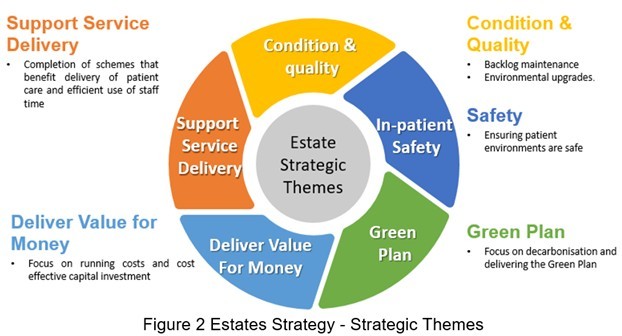
The various internal and external drivers are creating a number of strategic themes against which future estates requirements can be identified and these themes are illustrated in figure 2 below. The schemes that are identified in the capital program link back to one or more of these themes.
How Do We Get There?
This section describes the Trusts proposals for the Estate over the coming five-year period which will deliver on the “where do we want to be”. The key developments listed in this section are divided into those where current funding exists and those where no funding has been identified. It must be recognised that the available capital funding is limited and the plans that have been drawn up reflect this.
Funded Developments
Completion of Major Developments Currently Underway
A number of work programs and estates initiatives which form part of the key Estates changes for the next 2 years, have in part been developed prior to the writing of this strategy document, this includes:
The work associated within the following areas has been brought together under one program known as CEDAR which commenced the major elements of the construction program in 2020:
This scheme will result in adult secure services located on a single site at Northgate Hospital and young people’s secure services relocated onto Ferndene. These moves will enable site rationalisation, improved service productivity, a greater critical mass of clinical expertise and expansion to enable repatriation in line with national strategy and the Mental Health 5 Year Forward View.
Following the transfer of secure beds from Bamburgh Clinic, the building will be extended and upgraded to allow for the adult acute admission facilities from the CAV site to move into the vacated space.
The development will also free up space on the St Nicholas Hospital site, specifically Alnwood and Lennox wards, which could be utilised as an option for the relocation of the Older Peoples in-patient services from the CAV site.
The CEDAR development will deliver against each of the five strategic themes and at the Northgate site will remove a range of buildings that have high levels of backlog maintenance are of a poor quality and poor functional suitability.
Demolition of some of the older parts of Monkwearmouth Hospital has occurred (Dec 2022) and redevelopment of the site is underway and will be complete early 2024. The development will also see Boldon Lane Clinic, which is currently vacant, demolished and rebuilt and this will provide a new base for the CYPS service which is currently utilising high cost rented accommodation at Cleadon Park.
An artist’s impression of the redeveloped Monkwearmouth Hospital is shown below.
The Monkwearmouth and South of Tyne Developments will deliver against each of the five strategic themes and will remove a range of buildings that have high levels of backlog maintenance are of a poor quality, poor functional suitability and had associated safety issues related to structural deficiencies and asbestos contamination.
Benton House in Newcastle is a leased community property which has been utilised by the Trust for almost 20 years. In 2022 the Trust agreed with the new Landlord to extend the lease and occupy the whole of the building. The building has been refurbished in order to accommodate other teams, and this work will be complete in early 2023.
The additional space will provide an opportunity for services to relocate to Benton House. Work is currently underway with the CBU’s to identify and finalise those teams where relocation will deliver benefits, and it is anticipated this will result in the building being fully occupied by the summer of 2023.
The teams currently being considered for relocation include the community service based in the Molineux centre who are in high cost rented accommodation, the CYP CEDS North of Tyne (formerly EDICT) service who are looking to consolidate into a single location and the creation of a CYPS crisis team assessment centre which forms part of the UEC bid.
The Benton House scheme will deliver against a number of the strategic themes, in particular improvements to the quality and suitability of the estate following refurbishment, the delivery of cost savings associated with relocation from the Molineux Centre and is supporting service delivery through the relocation of teams.
The Hadrian Unit was a 22-bed mixed sex adult acute in-patient ward. The unit had a significant number of environmental and safety shortfalls, and these are being addressed as part of a comprehensive upgrade. The original plan was to reduce the beds to 20 and provide bedrooms with en-suite facilities along with other environmental and safety improvements and return the ward back to a mixed sex unit. During the upgrade the service moved the male patients into the former PICU unit and the CBU have decided they will operate this split service moving forward. The upgrade has been modified and now a number of bedrooms will not be upgraded and will instead be mothballed.
There is an opportunity to look at the bed model on the Carleton Clinic site to see if it can be used as a single site for North Cumbria bed-based services and facilitate the relocation of the Yewdale beds.
The Hadrian Unit upgrade will deliver against a number of the strategic themes, in particular improvements to the safety, quality and suitability of the estate following refurbishment and supporting service delivery.
Other Minor Schemes in 2022/23
At the time of writing this strategy a number of other smaller schemes are underway in the current financial year, and these are identified in the capital program. Collectively these schemes will contribute to the five strategic themes.
Prioritised Estates Work Streams – Business as Usual
A number of work streams which form part of the key estate developments that meet the strategic themes of this strategy for the next 5 years have been identified and are detailed below.
There is a continuing focus on reducing the backlog maintenance position. The capital programme has identified funding of £0.5M per annum to reduce backlog maintenance, focusing on significant and moderate risk adjusted backlog. Backlog will also be addressed through disposals of old estate in particular for the Northgate and Monkwearmouth sites.
The expenditure on backlog will deliver against a number of the strategic themes, in particular improvements to the safety, quality and suitability of the estate.
The quality of the patient environment and patient safety has been highlighted as a priority by the organisation. In order to address any minor deviations or areas for specific improvement which may be outside of a planned refurbishment program an allowance needs to be made in the annual capital program, and this will ensure issues can be addressed promptly.
The capital programme has identified funding of £1.2M/annum to improve the patient environment.
The expenditure on the patient environment will deliver against a number of the strategic themes, in particular improvements to the quality and suitability of the estate
The Trust needs to provide facilities for service users that are safe and minimise the opportunity for harm to be caused. Furthermore, facilities need to comply with legislation and CQC requirements which evolve over time.
Within the Trust the Clinical Environmental Safety Group (CESG) review the standards in place across the Estate with a view to identifying where safety improvements need to take place. The key areas include en-suite doors, CCTV standardisation, seclusion room upgrades and Oxehealth along with a number of other areas.
The capital programme has identified on-going funding of £0.8M/annum to improve safety for patients.
The expenditure in this area will deliver against the strategic theme of safety and will also contribute to the quality and suitability of the estate.
A survey of the estate has identified that significant capital investment will be required in order to achieve net zero by the Government target date of 2040 and this equates to an overall investment of around £30M.
The capital programme has identified on-going funding of £1.5M/annum to invest in decarbonisation energy efficiency, building adaptation and improving biodiversity.
The expenditure in this area will deliver against the strategic theme of delivering elements of the Green Plan and will also contribute to the quality and suitability of the estate.
In addition to the funded developments there are a number of schemes which have been identified by the Trust where a funding stream does not exist. These schemes include the relocation of the OPS service from the CAV site and the relocation of Rose Lodge onto a main hospital site.
The OPS service presents a significant risk to service delivery as the service are based at the Centre of Aging Vitality (CAV) which is owned by Newcastle University and leased to CNTW. The current lease expires at the end of March 2023; however, assurances have been sought from the University that these service can remain on site until autumn 2024. A business case has been developed which presents 2 principal options for the bed-based services; move into Alnwood following the CYPS move to Ferndene or construct a new build on the Collingwood Court footprint. Both options are unfunded and would not be complete until 2025.
The Rose Lodge scheme has not been considered in any depth in this strategy.
Potential Rationalisation and Disposal of Assets
The potential of asset realisation to create capital receipts for service development and reduce expensive overhead costs associated with property ownership, has been the subject of considerable work over the last few years. The Trust has a number of assets / surplus land that have been identified for disposal or potential disposal, these include:
Identified Asset Sales and estimated values
- Craigavon & land - £285k (sale underway)
Potential Asset Sales (or development opportunities)
- Hillview Clinic
- Rose Lodge
- Alexandra Lodge
- The Grange
- Land to the North of Carleton Clinic
- Portland Square
Land Sales and estimated values
- Surplus land at St Georges Park is part of the planned disposal strategy - £1.8M (sale underway)
- Northgate Hospital - surplus land not required under the CEDAR development, or for future needs - £7M (sale underway)
Where land sales or asset disposals are being considered a feasibility report will be completed and detailed action plans for each site disposal will be prepared. These plans include timetables for full business case preparation, internal and external consultation (where appropriate), planning applications and marketing. Each disposal will be the subject of an individual business case which will ensure that each disposal achieves best value, and the Trust will utilise relevant experts to ensure maximum value is delivered.
A plan for the delivery of the estates strategy with phasing of key schemes between 2022/23 - 2027/28 is shown in Table 2. At the front end of the programme, schemes have been prioritised which fit in with the current capital programme and the anticipated works associated with the completion of the CEDAR program. The plans are in some cases subject to the approval of individual business cases as appropriate, the availability of required capital and the outputs of more detailed operational planning to minimise the impact on service disruption.
| Trust Capitol Funding |
|
23/24 |
24/25 | 25/26 | 26/27 | Total |
|---|---|---|---|---|---|---|
| £'000 | £'000 | £'000 | £'000 | £'000 | £'000 | |
| Major Schemes | 35,150 | 8,755 |
0 |
0 |
0 |
43,905 |
| Other Developments | 1,407 | 1,213 |
0 |
0 |
0 |
2,620 |
| Recurring Estate Investment | 2,559 | 4,500 |
4,500 |
4,500 |
4,500 |
20,559 |
| Contingency | 0 | 0 |
1,500 |
1,500 |
1,500 |
4,500 |
| PDC Funded Schemes | ||||||
| UEC - North Cumbria | 467 | 2,664 |
3,131 |
|||
| UEC - Newcastle Gateshead | 1,000 |
1,000 |
||||
UEC - North Tyneside |
500 |
500 |
||||
| Total | 5,933 | 8,377 | 6,000 |
6,000 |
6,000 |
32,310 |
When formed in 2006, the new organisation inherited a large diverse property portfolio much of which was in a poor condition and had low levels of quality and functional suitability. That position has significantly improved over the last 16 years as a result of sustained and targeted capital investment. Whilst there still remains a range of accommodation which does not enhance the patient experience and is in need of improvement or replacement there are plans in place to address the majority of these areas.
The Trust is rightly proud of the significant advances in improving the quality of the patient environment it has made since its formation with many award-winning innovative capital developments which have been recognised for the contribution they make toward clinical care.
The Trust remains committed to a program of continuous development and improvement in the services it provides and this needs to be reflected in the environments provided for both patients and staff.
By ensuring the Estate Strategy is aligned with the Service Development Strategies, the Trust is confident that its substantial investment programme will deliver further improvements to ensure environments that are fit for purpose which will support the Trust in realising its vision to move forward as a market leader in the provision of mental health, learning disability and neuro rehabilitation services. These developments are also in line with the Department of Health’s guidance on how to efficiently manage estate, which combines the three strands of improving operational efficiency, improving construction efficiency and actively seeking opportunity through surplus land disposal.
The Estate Strategy has taken into account the Trust’s vision, core values and strategic objectives, in addition to the service-specific requirements as set out in the Trusts Strategy and to have ‘facilities fit for purpose’ that complement the service needs of the organisation.
The Estate Strategy provides a framework from which we will be able to monitor and measure our progress in ensuring that the Trust estate performance meets the expectations of the organisation in line with the substantial investment being made over the next 5 years. However, it will be imperative that the Trust ensures that any future investment is in keeping with the Trust’s strategic objectives and goals, core service requirements, models of care and best practice for estate management. The strategy is a dynamic document outlining a programme of work that will be reviewed regularly as service priorities change and development opportunities arise.